Tuesday, July 19, 2005

BEHIND YOU

The kitchen of the restaurant is hardly bigger than my own modestly sized bedroom. It is long and narrow, filled to capacity with stainless steel counters, shelves, pots, pans, and the all too familiar sink and sanitizer. During service, it is alight with frenzied activity: sizzling sauté pans, bubbling deep fryer, tense chefs and bilious sanitizer-steam. The six of us working there are intertwined in a delicate choreography. We are coordinating our movements, dancing the complicated culinary dance of a tiny kitchen. In order to prepare the food and keep the chef’s supplied with dishes and ingredients, we are all nimbly darting around each other in the tight quarters with a lightning speed that necessitates all our powers of concentration. Concentration and communication. In order to avoid huge collisions involving extremely hot pans and huge stacks of breakable dishes, there is a verbal code rigidly enforced. It is the key to the safety of all working in the kitchen. Whenever you are nearby or behind someone, you yell BEHIND YOU. Holding something hot: HOT HOT HOT. A knife in hand: SHARP KNIFE SHARP KNIFE. While at first I felt self-conscious and slightly silly always yelling out my location and what I was holding, I quickly understood the necessity. The red and blistery burn mark on J.’s neck, received in a surprise collision with an unannounced sauté pan, scared me into hearty narration of my every movement. And now it hardly requires a second thought – a light touch on the back and a piercing BEHIND YOU is my verbal code of choice.

And yesterday I was in the local Whole Foods wearing a grubby sweat shirt, my hair flying out in every direction, in desperate need of a coffee and in search of dinner ingredients. I was darting in and out of the throngs of Brooklinites who seem to do their shopping en mass at precisely 5pm every day, always standing with a full cart and a horde of tiny children directly in front of the exact item I need. I was having a hard time finding evaporated milk (for an experimental ice cream, but that’s another story in itself) and was careening up and down the isles. Slightly distracted by my frustrating search, I offhandedly noticed that I was getting some strange looks from those I passed. I know if look a bit disheveled, but I don’t think I look bad enough for these odd looks, I thought to myself disgruntledly. But then with a start, I realized that in my mad dash through the supermarket I had not been silent. Unconsciously, but with a consistency that would have made The Chef proud, I had been lightly touching the backs of all I passed and confidently belting out BEHIND YOU, hardly registering what I was doing. At least I know I’ll never be burned by a surprise sauté pan while grocery shopping.

Monday, July 18, 2005

decapitated sardines and flying saute pans

My two week hiatus from work during the restaurant’s summer vacation is over and I am back prepping and washing dishes at the bistro. I am still reeling as I type right now, even on my night off. The intensity of the kitchen never ceases to amaze and overwhelm me, no matter how much time I have clocked in thus far.

This week I spent countless hours plucking the blossoms and leaves off of fresh stalks of marjoram, wild sorrel, burnet, and a pungent black basil. I chopped cornichons, or tiny pickles, into a microscopic mince for garnishes. I cleaned arugula and black trumpet mushrooms. I peeled garlic and onions, tears streaming down my cheeks. I learned about the various stages of veal stock, an aromatic pot always bubbling away on the back burner, strained and intensified over and over before its flavor is fully deepened. I watched the preparation of guanciale, an intensely flavored dried hog jowl. I puzzled over the service of cock’s comb, which I was surprised to find out is truly the floppy red thing on top of a rooster’s head. This cartilage-rich chicken-plumage is cooked slowly to break down the naturally gummy gelatin and create a richly textured dish. I washed dishes with rhythmic efficiency.

What intrigued me most this week, however, was not the food. The human drama of the kitchen has me entranced.

I was standing over a mountain of fresh sardines: tiny silver heads and floppy decapitated bodies shimmerd while the red guts oozed out of their body cavities. Their glassy eyes, all two hundred of them, stared at me with an eerie vacant gaze. S., my co-prepper who speaks no English, and I were chatting (I’ve learned a remarkable amount of Spanish this summer) as we pulled the skeletons out of the fish-bodies and washed them out in a tub of cold water that soon turned the color of a deep red wine. I was trying to decipher S.’s long story about his brother in El Salvador when I heard a huge crash. I looked up to see The Chef, hair tied back in a ponytail and sweat streaming down his forehead, wielding a sauté pan in his right hand. He raised his arm over his head and with all his strength brought the pan crashing down against the counter again. There was utter silence in the kitchen. Even the rumbling sanitizer seemed to quiet down. The tension was so thick it could be cut with the dullest of butter knives.

“What the hell do you think you’re doing,” The Chef growled. His upper lip was curled like a snarling dog. He was looking straight at J., the hefty young sous-chef with a black bandana tied around his head and a look of utter terror in his eyes. J. looked dumbly at The Chef, fear written all over his face.

“I don’t know, Chef,” he said meekly. “I was trying to plate the pork.”

“Did you even look at what you were doing? Did you taste it? Look at this shit. This is the worst cooking I have ever seen.” The Chef didn’t raise his voice. “How dare you try and serve something like this here. In my kitchen. How dare you.” He made no move to slam any more sauté pans. But the raw edge of his voice, the crazy gleam in his eye, the ominous hum of the pork on the stove signaled trouble. J. obviously didn’t know how to respond, torn between defending himself or admitting his mistake. He hadn’t tasted the pork; he hadn’t plated it with perfection. J. simply shrugged his shoulders. This noncommittal answer was unacceptable for The Chef. There was a long pause in which the entire kitchen froze, time in slow motion, waiting for the explosion.

And then it came. “GET OUT OF MY KITCHEN. GET OFF THE LINE," The Chef bellowed, phlegm flickering at his lips. More quietly: "You are the worst chef I’ve ever seen. Come back when you are ready to cook.” J. looked like he was going to argue, then thought better of it. He walked out of the kitchen and into the back hallway, shoulders sagging and his head down.

It is difficult to explain the significance of being thrown off the line. It is a matter of lost honor, broken pride, the disruption of a chef’s basic identity. The kitchen is a battle ground on which line cooks valiantly fight the clock and the physical elements to deliver an aesthetic and gustatory experience for the diner. To be thrown off, publicly yelled at like a small child being sent to his room after a temper tantrum is the ultimate humiliation. It is a soldier being told he is not good enough to fight for what he believes in. It is a grown man being reduced to toddler.

There is no arguing with The Chef, though. He is all powerful in that tiny, sweltering kitchen. He is explosive and unrelenting. He meters out well-aimed blows to both sauté pans and egos. His anger sneaks up on you like a pouncing feline. The tough yet benevolent father of the bistro, his words can make or break you. One withering look sends you into paroxysms of guilt while his crooked smile and a playful punch on the shoulder inspires joyous waves of happiness. His charisma is undeniable. He is infectiously passionate and his driving desire for transcendent food is contagious. This intrigues me above all else: a personality of such overwhelming intensity and the reverberations in his small culinary empire of a kitchen.

When I later walked into the back hallway, J. was motionlessly staring into space. His eyes were empty, as if his consciousness had stepped out of the building and left his body behind. He was standing awkwardly, unsure of his footing. There was a smear of flour on his cheek and a large brown stain on his white chef-shirt. He looked rakish and wild; his atipically unkempt appearance suggesting that he lost not only his honor and coveted place on the line, but quite possibly his sanity as well. J. looked small. Lost. He slowly turned his head towards the sound of my footsteps, pivoting his head but not his body, and shook himself awake.

“I’m at my saturation point, Molly,” he said, gruffly. “I can’t take it anymore.” He opened his mouth and then closed it again, sighing deeply. He shook his head and then cleared his throat. Hearing those words come out of his mouth surprised him. As if saying it out loud finalized a sentiment he had long been feeling. He frowned, shook out his shoulders, and steeled his expression. “I’m going back,” he said. And he did. There were no more flying sauté pans; only bruised egos and a hearty dose of kitchen reality.

Tuesday, July 12, 2005

adventurous eating: quinoa and squirrels

My mom is squeamish when it comes to eating. And while she has made great strides in the last few years (goat cheese, wine) well-known and well-done are the most important descriptors of her food. Her meat always roasts on the grill for crucial minutes longer than anyone else’s, a lone steak ridding itself of all vestiges of pink center. Sushi scares her. The look on her face when I described the three-inch-long insect I (only somewhat hesitantly) consumed while traveling in China last summer was priceless. She thinks tofu is a slimy, disgusting mess and recoils in horror at the thought of many of my “bohemian” eating habits.

She loved, however, my quinoa salad. And as a key component in my crunchy hippy diet, this says a lot.


Quinoa is a relatively new addition to the North American market. It has been cultivated in the Andes for more than 5,000 years, the sustaining force of the Incan diet. Nutritionally, quinoa is a super-grain containing amazing reserves of protein and iron. Technically, however, quinoa is the seed of a leafy plant (distantly related to spinach) and no grain at all. Whatever it is, though, it is delicious. Quinoa cooks to a light, fluffy texture; a soft grain with a crunchy external tail and a deeply nutty taste. Delicate and golden brown, the fragile appearance belies a strong structure that holds up to a myriad of tastes.


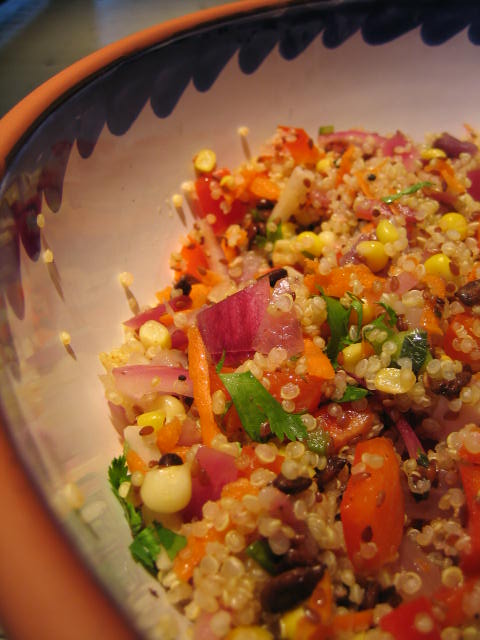
This is the most beautiful salad I have ever made, hands down. The colors are phenomenal. It looks like box of crayons, a sky-view of the Macy’s Day Parade, my ridiculous shoe collection. The combination of crunchy vegetables and soft grain combine in a satisfying texture. The zesty marinade does not overpower the fresh taste of the farmer’s market. Three different kinds of toasted seeds give an unexpected richness.


My mom even ate the leftovers. This is a true culinary triumph.

On another, slightly related note: In the past few years I have amassed an odd stock of t-shirts. One reads Alabama: So Many Recipes, So Few Squirrels in block letters across the front. It tickles me (and was on sale). I was decked out in all its squirrel-glory when a pair of young, fresh faced Mormon men came to my door the other day. They were nervous, stumbling over their words. My street was one of the first stops on their two year mission of conversion and they seemed disappointed that I wasn’t all that excited to talk about Jesus. (I don’t know why they were surprised; I live down the street from an orthodox synagogue and next door to a lesbian couple. A Mormon’s mission in Brookline seems doomed to failure.) But when they saw my t-shirt they warmed right up. As it turns out, they have a good friend serving his mission in Alabama. And, they informed me, squirrels are indeed often on the menu there. We chatted about different rodent recipes for a while. They were very nice; I even agreed to read one of their pamphlets on Mormonism.

And now I can’t help but wonder: what do squirrels taste like, and would my mom ever eat one?


Quinoa Salad
adapted from Peter Berley's The Modern Vegetarian Kitchen

For the salad:
1/3 c. sesame seeds

1/3 c. sunflower seeds

1/3 c. pumpkin seeds

½ tsp. sea salt

1 c. quinoa

Kernels from 2 ears of sweet corn

1 red onion, diced

1 red bell pepper, diced

1 bunch red radishes (8-10), trimmed and cut into matchsticks

1 large carrot, grated


For the marinade:

½ c. cider vinegar

1/3 c. olive oil

1 small bunch cilantro

2 scallions, chopped

1 jalapeno pepper, minced

1 garlic clove, minced

Sea salt

Fresh ground pepper


- preheat oven to 375


-spread seeds on a baking sheet and toast in oven for 10 minutes. Pour them into a bowl and set aside to cool.

-in a small saucepan over high heat, bring 1 ½ c. water to a boil with a pinch of salt. Add the quinoa. When the water returns to a boil, reduce the heat to low, cover, and simmer for 20 minutes or until all of the water has been absorbed. Spread the quinoa on a baking sheet to cool.

-in a pot fitted with a steamer, combine the corn kernels with the red onion. Steam for 3 to 5 minutes, until crisp-tender. Remove to a colander and chill under cold running water. Drain thoroughly.

-to make the marinade, combine the vinegar, oil, cilantro, scallions, jalapeno pepper, garlic, 2 tsp salt, and black pepper to taste in a large mixing bowl. Whisk well.

-add the toasted seeds, quinoa, steamed vegetables, red pepper, radishes, and carrot to the marinade.
Mix well and refrigerate for at least 20 minutes to marry the flavors.

Monday, July 4, 2005

on taste and tobias: back to earth with gazpacho

I sat on a hard gray bench; the wind violently whipping my hair, bright sun soaking into my shoulders. People were laughing and chatting all around me, moving wobbly on the rocking ferry boat. A plump brunette woman napped against her tattooed boyfriend, his leather jacketed shoulder a soft pillow. A hip looking younger man wearing a bright blue bandana painted bright smears on a canvas near my feet. Muscled, bronze men sipped Bloody Marys, leaning comfortably against the railing, looking out at the calm sea. The early ferry to Provincetown from Boston to kick off the Fourth of July weekend contains an interesting crowd. But I could hardly do justice to my usually passionate people-watching. I sa t there for two hours, hardly comprehending what was going on around me, lost in a book.

Tobias Wolff’s Old School is a short novel, one that I randomly grabbed from the bookshelf on my way out the door. But once I started reading I was lost. I was completely entranced by the narrative, the words. I left my body for the world of the novel. I haven’t had that sensation of involvement and total immersion within a book in a long time. By the end, college had given all reading, for class or fun, a repugnant aura of intensely academic over-analysis. I lost the ability to lose myself in the moment of reading, of wholly traveling to the realm of the story. But in the most unlikely of places this Saturday, that bench on the deck of a crowded sea-vessel, I entered completely into the world of Tobias Wolff’s boarding school narrative. I practically forgot to breath I was so intent on devouring the words and turning the pages.

The story itself (an intriguingly woven boy-to-man tale, piercing and believable) is not so important for these food-blogging purposes. As strange as it sounds, it was the feeling of complete bodily abandonment juxtaposed with a summer’s evening gazpacho that was the most interesting revelation.

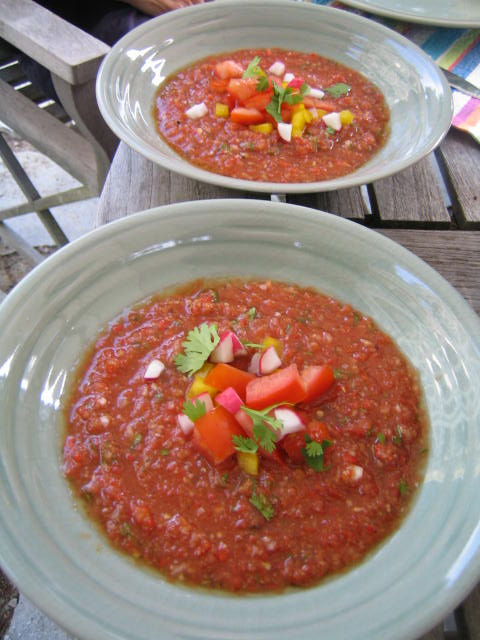
Reading so intently I felt as if I had abandoned my body, lost in that book I was without all normal bodily sensation. I was left with only words, story, internal literary imaginings. And eating the freshly chilled soup later that night my tongue and I were very much grounded in the wonderful physical reality of taste. With the first spoonful of gazpacho – the tangy jolt of sherry vinegar, garlic and cilantro; the visual feast of reds, yellows and green – I felt the full extent to which I had previously lost my senses to the literary world. It was a surprising taste awakening. One that brought me back to earth and made me feel very much alive.

I would like to have Tobias Wolff over for dinner. I wonder if he likes gazpacho.

Gazpacho
Adapted from Tyler Florence and the Food Network (loves of my life)

3 slices wheat bread, crusts removed

2 pounds vine-ripe medium tomatoes, seeded and coarsely chopped
1 cucumber, seeded and coarsely chopped
1 red bell pepper, cored, seeded, and coarsely chopped
1 medium onion, coarsely chopped
2 garlic cloves, chopped

1 jalepeno pepper, minced

2 cups tomato juice (the organic kind from whole foods, yum)

1 tablespoon sugar

1 tablespoon Spanish paprika

salt and pepper

1/4 cup sherry wine vinegar

1/2 cup extra-virgin olive oil

1 handful cilantro, coarsely chopped

1/2 lemon, juiced


-Soak the bread in 1 cup of water for 5 minutes, and then squeeze out the excess water.

-Place the bread in a blender or food processor; add the tomatoes, cucumbers, bell pepper, onion, garlic and jalapeno.

-Puree the ingredients until slightly smooth, keeping a modest amount of texture.

-Pour the vegetable mixture into a large bowl; stir in the tomato juice, sugar, paprika, salt, pepper, vinegar, oil, cilantro, and lemon juice until well combined.

-Refrigerate a few hours until very well chilled; the flavors will develop as it sits.

-Garnish with chopped yellow pepper, radish, tomato, avocado, and a few more leaves of
cilantro. (Adding color and crunch). Do another round of salt and pepper before serving.

Friday, July 1, 2005

little cake, big hands, massive passion

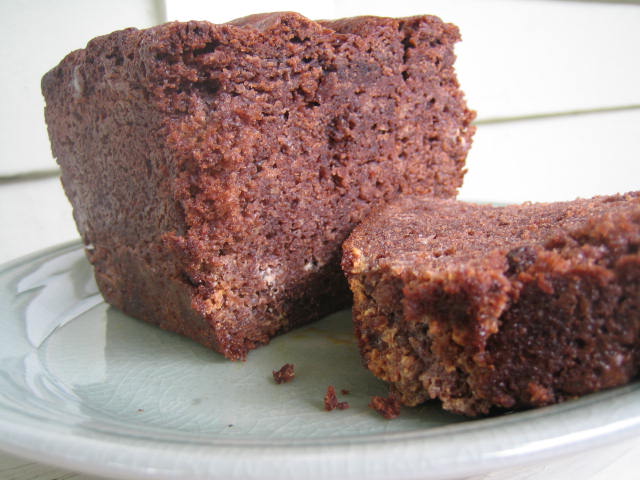
I was standing in the center of a car-less parking lot, surrounded by bustling people lugging plastic bags of fruit and vegetables, a misty layer of sweat on my forehead and deeply inhaling the smell of fresh basil. I watched from behind a stack of rhubarb as a tall man with a pink, weather-hewn face and crinkly long red hair smiled as he greeted a customer, radiating a sense of affability. He was wearing worn denim overalls, a rumply white shirt. His tan, freckled nose and the obvious but hidden muscles, lurking under his bilious clothing, were the mark of what I would consider a stereotypical farmer. He towered over the makeshift wooden table, his own stall at the farmers market in Coolidge Corner yesterday. His giant frame, dwarfing all others, was made even more acute when seen in context of his goods for sale. The tables surrounding him were covered in displays of tiny pies, little cakes, and stacks of cookies. Flakey pie crusts oozing blueberry and raspberry juices; golden pumpkin streusel cakes in mini aluminum loaf pans; chocolate chip cookies larger than my head (yet I imagine still smaller than his massive hands). I was drawn to the man’s quiet happiness, the wild looks of pleasure flashing on the faces of his customers, and who am I, really, to pass up a baked good. I extricated myself from the rhubarb and approached the table gingerly, mesmerized by the cakes, the seller, and only somewhat worried about my lack of self control in the face of butter and sugar. My eyes were immediately drawn to the towering mountain of a large chocolate loaf, its formidable sides in crusty peaks, reminding me of drip sandcastles on the beach.

The pink-faced farmer saw me eyeing the voluptuous cakes, practically drooling. He picked one up and held it out to me. Even through the cellophane wrap I could smell its buttery richness. This week we ran out of dark chocolate chips, the man said softly, almost nervously, in a deep voice. The gruff tambour of his speech perfectly suited his wide mouth and rough face, but was jarring in relation to his sweetly concerned words. I’m really so very sorry, but this morning we just ran out. I don’t want any of our regulars to be surprised or upset, so I need to warn you that we used white chips today.

When I seemed confused, he asked if I had ever had their Chocolate Banana Sour Cream Cake before. No. He smiled at the cake, lovingly; and he smiled at me, like he knew a secret I couldn’t possibly yet understand. Of course I bought some – he handed it over delicately, cradled as carefully as a newborn baby. I didn’t say anything; I was in awe of the love this man possessed for his work and his product. I was struck dumb and mute by the sheer passion that he exuded simply holding a chocolate loaf or peach pie, each dwarfed in his large hands. I paid and slipped silently away, clutching my cake, wondering if my obsession could ever possibly match his in pure force and happiness.
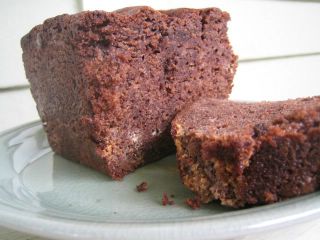
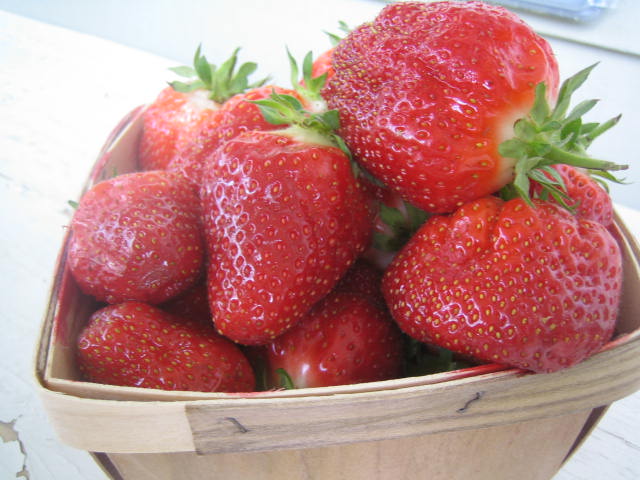
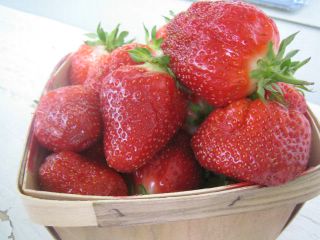
I walked home happily, a buoyant spring in my step despite the fact that I was practically swimming in Boston’s summer humidity. I unloaded my bag, and besides my cake took out a bundle of bright, crisp radishes, a cluster of juicy tomatoes, a pot of ginger-fig jam, and two quarts of burstingly ripe strawberries.
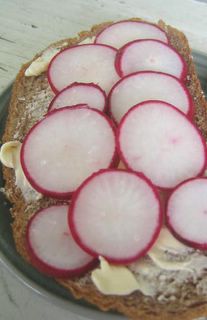
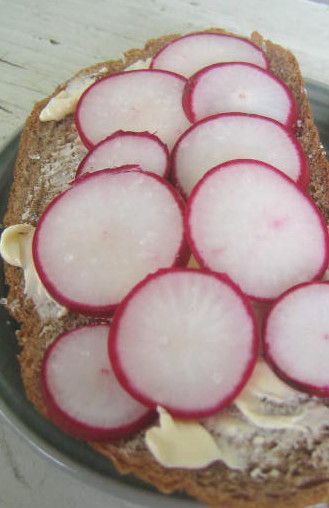
I created a masterpiece of lunch with my farmer’s market bounty: fresh wheat bread slathered with butter, topped with thinly sliced radishes and a smattering of sea salt. Crunchy red-rimmed radish against the cool creamy butter, the perfect bite of salt. A peach, explodingly ripe. And a huge hunk of chocolate banana cake – moist and rich, gooey with a crusty rim - alarmingly addictive. That stuff should be monitored by the FDA it’s so good.

I later sat surveying my mountain of ripe strawberries; a pile larger than any one house of humans could possibly eat.
I was pondering what to do with them, unsure why I bought so many, when an image of the dark corner of my basement immediately infiltrated my mind’s eye. A dusty shelf stacked with a plethora of random plates and utensils brought home from my college apartment, a fish poacher, panini maker, and an ice cream machine. When Becca and I moved into our apartment last year, we possessed none of the necessary kitchenware, not even a table. We also, collectively, had a dearth of money. We went to the mall, hoping to buy some of the basics – so at least that we didn’t have to eat off the floor that night. The only thing we came home with, however, was an ice cream maker (and decidedly smaller bank accounts). Of course we never regretted that purchase, despite the fact that it was used a pitifully few number of times in the last year.

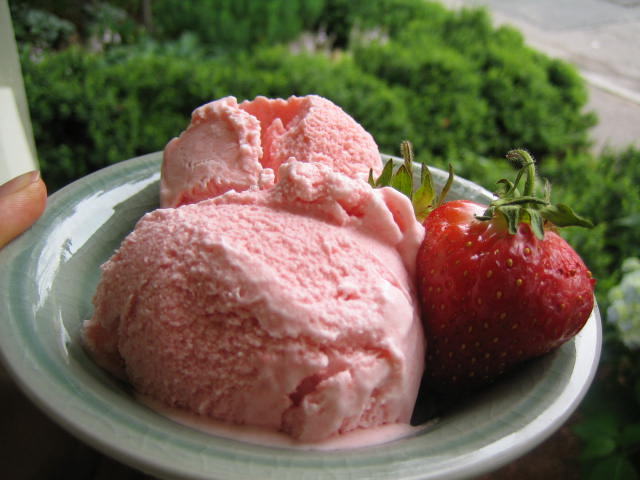
Yesterday, though, the ice cream machine was resurrected in all its former glory to create the perfect food for a day that made me sweat just walking to the fridge. I rubbed the ripe berries against a sieve, catching the juice and puree, leaving the seeds. I added citrus and sugar; whipping cream beaten to soft peaks. And what I ended up with was a soft and richly flavored strawberry ice cream – filled with pure summer and so far in taste from the preservative-pumped supermarket brands that it should be considered an evolutionarily miracle and taxonomically re-labeled.
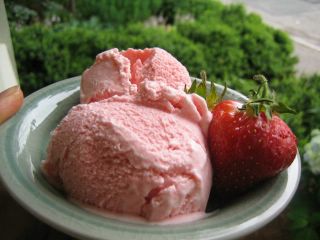
My first bite of the cold pink ice cream was sweet, smooth, frothy, and infused with the sun, earth, and vines of the farm-fresh berries. I didn’t speak for a moment, mute with pleasure. And that’s when I realized that though I may not have hands the size of 10-inch peach pies, I certainly do have the ability to happily strike myself dumb with culinary passion.

Strawberry Ice Cream
Adapted from Shona Crawford Poole’s Ice Cream

1 quart of ripe strawberries, hulled

juice of one orange

juice of half a lemon

juice of half a lime

a scant ½ cup of sugar

¾ pint whipping cream, chilled


- rub the berries through a sieve, keeping the juice and discarding the seeds and solids.
- combine the strawberry with citrus juices and sugar, letting it sit for a few hours in the fridge to marry the flavors.
- whip the cream into stiff peaks and then fold it into the fruit puree.

- freeze in an ice cream machine.
Tuesday, June 28, 2005

a post-cleaning blueberry cake

I woke up Monday morning to hear the twittering of those tiny birds who are roosting on the roof, the dulcet sound of a humming air conditioner. I could smell coffee and a hint of cinammon, brewed hours before yet still pungent. I stretched out in bed, the sun shining through my window, pondering the patterns of light illuminating the piles of dirty clothes strewn all about the room. I was slightly groggy, somewhat sore (who knew mopping could work so many muscles?), and giddy with the prospect of an entirely free day.

I had planned on instituting an immediate plan of vacation-action: To Explore Boston, a city that I know sadly little of. Days after graduation I had left for Israel, returning to Boston only to begin work the next day. There has been no time yet to feel comfortable in the city, like I belong here. But true to my Brunonian background, whenever there are other ‘larger’ things to be done it seems like my productivity facilities shutdown and I immediately revert to some kind of procrastination. And after that last night’s 11-hour stint of hard core cleaning, my mind and body united to tell me one thing and one thing only: bake a cake.

Looking in the refrigerator for inspiration, I found a magnificent pint of blueberries. Poppingly ripe and almost blackly-blue, they are the soul of my blueberry coffee cake with a crunchy toasted pecan crust.

When I later pulled the cake out of the oven I could hardly wait for it to sufficiently cool before cutting a generous slice. Its smell immediately brought me back to when I was ten - the small cluster of blueberry bushes near my aunt’s lakeside house in Pennsylvania, my mouth stained blue, juice dripping down my chin, the berries roasting in the hot summer sun. The cake itself was soft and light, gooey and steaming blue with burst berries. The crust was a perfect combination of sweet and crunchy – the toasted pecans add an extra oomph of rich nutty texture.

I took my piece of blueberry cake, a steaming mug of coffee, and the new David Sedaris book out onto the shady porch. I sat there for a long while, perfectly content. Emily and Sarah, my oldest, comfiest friends, soon arrived and had no problem helping me in the cake eating fest. Later, though, we did go out to explore Boston, laugh over food and wine while perched at a breezy outdoor table, and talk about where this so-called "Real World" is taking us.

I maintain, though, that any talk of the Real World must be preceded by cake. It is much more palatable that way.


Blueberry Coffee Cake with a Crunchy Pecan Crust
adapted from The Gourmet Cookbook

2 c. flour
2 tsp. baking powder
3/4 tsp. salt
1 stick softened butter
1 1/4 plus 3 tbs. sugar
2 eggs
1/2 tsp. almond extract
1/2 c. milk
3+ c. blueberries (I like to err on the side of more)
1 egg white
1 1/2 c. toasted pecans, roughly chopped

-preheat oven to 350 and grease a 2-3 inch cake pan
-sift together flour, baking powder, and salt into a bowl.
-combine butter and 1 1/4 c. sugar in another large bowl, beating it until pale and fluffy. Then beat in the eggs, one at a time, then the almond extract. Slowly add the flour, alternating with the milk, until it is just incorporated.
-fold in the berries and spoon the concoction in to the baking dish.
-in another bowl, stir the egg white, pecans, and remaining sugar until coated. spoon the mixture evenly on top of the cake.
-bake for around 45-50 minutes, or until golden brown and a cake tester poked into the center comes out clean.


Monday, June 27, 2005

to understand a head of garlic...

Last night was long. I came home and collapsed into bed at 3:30am. It was a sleep filled with anxious dreams of crispy gold shrimp tempura and miles of dirty dishes being simultaneously consumed and washed, a never-ending stream of culinary duties.

In the kitchen we first powered through an interesting service: a four course fixe price tasting menu for all patrons. It was a somewhat successful attempt to clean out the walk-in fridge and serve everything that could possibly go bad in the next two weeks. No two tables ate the same thing; it was all a matter of the Chef’s gastronomic whim. Along with the Chef's interesting culinary prowess, (which I felt almost embarrassingly honored to watch, adoringly wide-eyed from behind the sink), this serving style also generated an obscene amount of plates to wash and appliances to clean.

When we started service the Chef looked at me, smiled broadly and said, clapping his hands: “This is what I live for, Molly. This is life.” His close-to-crazy happiness and radical passion radiated out of his body, from the wrinkles in his loose cotton chef pants to the tiny pores of his long nose. I, in turn, felt almost freakishly energetic, inspired by the creative cooking and collective energy in the kitchen.

But then, beginning at midnight, we began the long clearance of the perishables, a massive cleaning and preparation for vacation. By 2am S. and I were jumping up and down, playfully yelling ‘rapido rapido’ to an empty kitchen, attempting to motivate ourselves to finish our work and break through the haze of exhaustion. By 3, we were slogging through a perpetually not-quite-done mess of a sink, silently cursing the (extremely high) night manager who just wouldn’t let any little smudge on the fridge door slide past his observation.

I woke up this morning feeling slightly frustrated. After a quick talk with the Chef after service, I realized that I had been harboring secret visions of myself quickly and triumphantly donning chef whites and pleated toque, manning the saute pan with a genius that has not yet been witnessed by mankind. Not surprisingly, this is a tad unrealistic (besides the fact that no one at the restaurant wears a toque). This internship, I now fully understand, will largely be self-taught through observation. I think that it is difficult for me, coming from my academic background, to completely submit to this slow, physically exhausting learning curve.

But when I subtly inquired about a possible increase in direct culinary teaching after vacation, the Chef simply said: “The only way, Molly, to understand a head of garlic is to work with it every day, taste it, feel it, grow with it through the changing seasons. Garlic in May is a different species than garlic in December. It may sound cheesy, but I strongly feel that the only way to be a great chef is to understand your material, instinctively and experientially from the bottom, no matter how long it takes.” So, sans toque and however frustrating, that is what I'll be doing. In two weeks I will continue to gain a slow yet solid knowledge of the bottom of the (no pun intended) culinary food chain, not to mention an addiction to Advil and caffeine.