Many things changed in the last few weeks of April. I was accepted into graduate school and mulled heavily over whether or not to attend. I helped to throw a (massive) dinner party. The trees sprouted, crocuses popped their heads out of the earth, and I began sneezing myself into fitful nights of hay-fevered sleep. One of my roommates decided to move and Jon and I began to search for a replacement. I said 'yes' to returning to school just the other day and then gave a two-month notice at my job.
And so I suppose it’s not so very surprising that amidst all that change there have been other, smaller adjustments as a result. For example: my daily excursion from the office to re-caffeinate myself. Every afternoon I steal out of work and take a walk, punctuated with a large cup of coffee. In the last few weeks, however, I've often found myself strolling down Madison Avenue in midtown Manhattan not with coffee, but with an ice cream cone in hand.
The effect that ice cream has on my mood can be drastic and is a phenomenon widely noted by those close to me. Some have even suggested that there may be something wonky with my brain's wiring. Even on days where the stress of impending decisions mixed with the exhaustion that comes hand-in-hand with my Spring allergies feel like they may swallow me up whole or cause me to "inadvertently" kick the next person who gets in my way as I walk down the street, a scoop of chocolate can pull me out of my grumpy abyss to be a functional human.
There is something inherently cheerful and child-like about the act of walking down the street holding a cone. When I studied in Florence for a semester, the first thing that struck me about the city wasn't the massive Duomo or the colorful buildings overlooking the river Arno, but was the sheer number of people traipsing down the cobblestone streets with cones of gelato in hand. They weren't just tourists, not only children – but white-haired, stooped grandmothers and business men in suits, couples in love and groups of young men wearing ripped jeans and leather jackets. It was normal to walk down the street with an ice cream cone and I loved that.
And I'm not sure if my daily ice cream excursions help in the decision-making processes or stress-reduction attempts. But they are an excellent distraction (it's important to concentrate on the physics of the cone as you eat and walk, so that nothing melts onto your clothing and you don't inadvertently walk back into the office with chocolate smears on your nose) and certainly made me a more palatable individual to have in the work place.
This weekend, however, I decided that for the love of my arteries and bank account I should instigate a bit more change into this new routine. With the inspiration of David Lebovitz's cookbook "The Perfect Scoop," I made frozen yogurt. I love the tangy, slightly sour taste of plain yogurt – here it is chilled and churned with a bit of sugar. It is reason enough to transplant my daily fix from Madison Ave. to the shady stoop of my apartment. Now I just need to go to the store and buy some cones.
Plain Frozen Yogurt
loosely inspired by The Perfect Scoop, and Heidi's 101 Cookbooks
3 cups Greek yogurt (I used Fage Total)
2/3 cup sugar
Mix together the yogurt and sugar until dissolved. Refrigerate for at least an hour, and then churn in an ice cream maker, per the instructions of your specific model.
Monday, May 7, 2007
Tuesday, May 1, 2007
Brooklyn Food Group
The last loaf of bread came out of the oven golden brown and crusty. An instant thermometer stuck in its meaty belly registered a perfect 200 degrees. With hands in oven-mits, I placed it to cool on a rack on the kitchen table. Seven other loaves— equally bronzed, slightly misshapen and dimpled—perched nearby.

Later we went to a nearby bar to decompress and celebrate. It was a day that began with a herd of bread and ended with a round of toasts.
*check out onenicething's flickr page for some beautiful photos!

Though I’ve been baking a lot of bread lately, this was the first time I had attempted any form of mass production in my tiny kitchen, in my tiny oven. And this bread was important. Sliced, piled on trays, and perched on the white linen of three long dining tables, it was the first thing the 28 guests would encounter as they arrived that night for a meeting of the “roving supper club” orchestrated by me and my friends Ben and Philissa.
Our supper club was an informal, semi-spontaneous gathering of friends—an eclectic group, of all ages and professions—who came together for an evening and an inventive five-course meal. We cooked and served in the spacious apartment of a friend. Ben - a talented self-taught chef and teacher by day - reigns over the savory while I am pastry chef. I have found that baking involves an exacting adherence to science, a precision of touch and aesthetic view; I don't need a full sense of smell to succeed.

We had been talking about beginning this supper club for a while. We had tested recipes and planned menus, debated venues and price. But despite our enthusiasm it was a large undertaking and I was not sure it would ever come to pass. But then (and what felt like suddenly) it did. Emails were sent and RSVPs taken; chairs and tables and crate loads of plates were rented. Menus were printed and tables set.
Ben played with homemade stocks, soups, and picked vegetables. He debated buffalo versus steak. Trout versus tuna. Grits and risotto. Morels and portabella. Sunchokes and ramps. I played with raspberry gelees and peppered biscotti. Ginger snaps and shortbread. Ice cream bases were created on a tipsy Friday at midnight. Fermenting bread base littered my apartment’s refrigerator.
And around 7 on that Saturday night guests began trickling in. Bearing bottles of wine they congregated in the dining room as the light slowly faded outside. Ben and I, sectioned off in the small kitchen with strategically placed tapestries, moved quickly to get everything ready to the background sound of laughter and clinking glasses.
When all twenty-eight guests had arrived and settled in, we gave a few words of welcome and introduction. People sat at the three long, white-linened tables, a menu perched at their place. It was quite a group—mainly friends and friends-of-friends, but ranged from teenage to grandmother, work colleagues and bosses to dancers and writers, comedians and bankers.
Ben and I scurried back to the kitchen to begin plating the first course. Philissa, who decorated the apartment beautifully, helped serve.
Preparing and executing all that food for so many people was wild and perhaps a bit crazy. It was a night filled with movement and hectic timing. There was a constant sense of urgency; adrenaline soared. The possibility of catastrophe lurked.
We moved quickly through the kitchen—grilling scallions, searing meats, spooning a nutty brown romesco, poaching asparagus. Bent over the white dishes lined on an overturned bookshelf, we plated each course with attentive detail. The close quarters, the heat of the oven and the constant desire for speed reminded me of when I worked in the restaurant in Boston. Time flew. Against the hum of chatter and merriment, I concentrated on the immediate sizzle and sear, steam and boil. I could feel the heat of the oven, an occasional flash of burn on my hands as I grabbed pots and pans, the weight of plates in my hands as I brought them out to the smiling eaters.
Later, guests said that they had no idea how hectic it was in the kitchen. They just registered the calm presentation of food, in evenly-spaced courses. And that was the point, I suppose. Just as when I worked in that Boston kitchen, the steaming speed of the grill line and the Chef, the yelling and the slamming of sauté pans was a world so far removed from the dining room only three feet away. Adrenaline propels the food to its calm destination.

The first course, “Bites of Spring”, was a plate containing three small creations. Vanilla-poached asparagus on toast with lumpish caviar; a caramelized cipollini onion topped with goat cheese and a spiced pistachio; a sautéed morel mushroom filled with confit garlic grits.
Then came “peas and carrots”: two small bowls, one of pea soup with mint and paprika oil, the other of carrot-carrot consommé with tarragon and toasted almonds. A slice of oozing grilled cheese sat in between.
Next was a seared filet of trout balanced on a salad of fennel, orange, grape, and tarragon-mint chimichurri.
Then, slices of flank steak were laid over parsnip coins, grilled scallions a la plancha, a dollop of a rich and bronze sauce romesco, a dollop of pickled red onions on top.
For dessert were individual molten chocolate cakes nestled in ramekins, a scoop of salted caramel ice cream by its side. I was very proud -- when the piping hot cakes arrived at the tables there were quiet moans of pleasure. Later, with tea and coffee, came plates of ginger snaps and lemon shortbread.
Later we went to a nearby bar to decompress and celebrate. It was a day that began with a herd of bread and ended with a round of toasts.
*check out onenicething's flickr page for some beautiful photos!
Thursday, March 29, 2007
Bread Bender
I spent a lot of time reading in the months after I was hit by a car. It began slowly; as a result of my skull fracture it was weeks before I could fully focus my eyes. But once I repossessed control of my mind and my sight, I camped out in a makeshift bed in my mother’s living room—my knee encased in bandages and a hefty metal brace, broken pelvis aching, wobbly crutches nearby—and surrounded myself with books.
It was a time rife with solitude. The days were long, with my mom at work and my friends scattered around the world. I was largely alone; it was easy to imagine that no one had ever felt so shattered.
I read Joan Didion’s The Year of Magical Thinking straight through in one rust-colored afternoon. She wrote it in the year after her husband’s sudden death, while their only child was severely ill. It is a narrative of her grief, written in language simple yet utterly evocative. Her “magical thinking” came in the vice of believing her dead husband would return, just as I—lying there with a long noxious bruise running down the side of my face and neck, monotone nothingness where my sense of smell once was— believed that my life would be the same once I could move again. As I read, I didn’t feel so alone.
Those months of recovery feel like a very long time ago looking back, though it was only a year and a half. Now, amid the oft-overwhelming clutter and crowd, the fast-paced movement of my life in New York, solitude is something I miss. I’ve never been good at finding the median.
But when I saw that Joan Didion had turned her book into a play, with Vanessa Redgrave playing the author, I immediately bought myself a ticket. I took myself alone on a Monday night after work.
It is a one-woman production: Vanessa Redgrave sits majestically in a wooden chair alone on stage for an hour and a half monologue. Her voice is rich, melodious. Her white hair pulled simply back from a chiseled face. She embodies the language of Joan Didion perfectly. I sat in the back corner of the dark theater, and found myself struck with memories of when I first read the book, in that time surrounding the accident. Things I hadn’t thought of in a long time.
At one point, Didion/Redgrave speaks of being with her very-sick daughter in the hospital. She wanted nothing more than to take her back to the hotel, to sit by the pool and get manicures together, to have her daughter’s hair washed in the salon. Then, at least, she would be doing something concrete to take care of her.
I suddenly remembered my own mother, who, soon after I returned from the hospital last year, brought me to the salon to have my hair washed. My body ached as they rinsed last vestiges of the accident off my skull. It hurt my broken pelvis to sit in their hard plastic chairs. I didn’t want to tell my mom, though; she was taking care of me.
When I left the theater that night I was immediately surrounded by the neon lights and the raucous throngs of people in Times Square – the night air felt stale and my shoes were cutting into my heels. But despite that, I took a deep breath and felt, for the first time in a while, that I had given myself the time and space to process what was going on around me, undistracted by people or work.
It is easy to get caught up in the ferocious movement of New York City. But ever since seeing the play I have been actively trying to give myself more space.
And this is my meandering transition to the culinary. As part of my “more time to think” campaign, I have been on a serious bread-baking bender.
There is no hurrying bread. Baking forces me to slow down; I take my time in the kitchen. On Saturday mornings, when I haul out my Kitchenaid mixer, my apartment is filled with light. The yeast bubbles softly in warm water before I add flour. The dough goes from sticky to supple as I knead it on my counter. My mixer is bright red and my apron has three little buttons the same shade of brown as the rising dough. The oven is warm and the tea kettle leaves a faint mark of steam on the nearby window. The corners of the bread pan are perfectly pointed. I let my mind wander.
And as the bread bakes my apartment is filled with a nutty, sweet perfume. It is a scent that my ravaged olfactory neuron can now detect—perhaps not in its entirety, but enough to feel its coziness.
Peter Berley’s recipe for a plain, white loaf was my most recent success.

Basic Yeast Bread: The Straight Method
Adapted from Peter Berley’s The Modern Vegetarian Kitchen
1 teaspoon active dry yeast
1 1/3 cup lukewarm water
1 teaspoon honey
2 tablespoons olive oil
2 teaspoons salt
3⁄4 cup whole wheat flour
3 cups white, unbleached bread flour
1. In a large bowl, combine yeast, water, and sugar. Stir to blend and let stand until foamy, about 5 minutes. Stir in oil and salt.
2. Add all of the whole-wheat flour and enough of the white flour to form a ragged mass of dough. Scoop out onto a clean, lightly floured surface. Wash out the bowl and clean and dry your hands.
3. Knead for 10 minutes, until smooth and elastic
4. Lightly coat the inside of the bowl with oil. Turn the dough over several times in the bowl and cover tightly with plastic wrap
5. Refrigerate the dough for at least 12, up to 48 hours
6. Remove the dough and let come to room temperature, about two hours
7. To shape the dough, gently press into 1-inch-thick circle. Fold down the top third and up the bottom third, pressing the seam together with fingers. Place in a lightly greased bread pan seam side down. Cover with damp towel. Let sit one hour, until has risen a bit more.
8. Uncover and brush with oil or a bit of melted butter.
9. Bake for 45 minutes at 400 degrees. When it comes out, a thermometer stuck to its center should read 200.
10. Let cool before slicing
It was a time rife with solitude. The days were long, with my mom at work and my friends scattered around the world. I was largely alone; it was easy to imagine that no one had ever felt so shattered.
I read Joan Didion’s The Year of Magical Thinking straight through in one rust-colored afternoon. She wrote it in the year after her husband’s sudden death, while their only child was severely ill. It is a narrative of her grief, written in language simple yet utterly evocative. Her “magical thinking” came in the vice of believing her dead husband would return, just as I—lying there with a long noxious bruise running down the side of my face and neck, monotone nothingness where my sense of smell once was— believed that my life would be the same once I could move again. As I read, I didn’t feel so alone.
Those months of recovery feel like a very long time ago looking back, though it was only a year and a half. Now, amid the oft-overwhelming clutter and crowd, the fast-paced movement of my life in New York, solitude is something I miss. I’ve never been good at finding the median.
But when I saw that Joan Didion had turned her book into a play, with Vanessa Redgrave playing the author, I immediately bought myself a ticket. I took myself alone on a Monday night after work.
It is a one-woman production: Vanessa Redgrave sits majestically in a wooden chair alone on stage for an hour and a half monologue. Her voice is rich, melodious. Her white hair pulled simply back from a chiseled face. She embodies the language of Joan Didion perfectly. I sat in the back corner of the dark theater, and found myself struck with memories of when I first read the book, in that time surrounding the accident. Things I hadn’t thought of in a long time.
At one point, Didion/Redgrave speaks of being with her very-sick daughter in the hospital. She wanted nothing more than to take her back to the hotel, to sit by the pool and get manicures together, to have her daughter’s hair washed in the salon. Then, at least, she would be doing something concrete to take care of her.
I suddenly remembered my own mother, who, soon after I returned from the hospital last year, brought me to the salon to have my hair washed. My body ached as they rinsed last vestiges of the accident off my skull. It hurt my broken pelvis to sit in their hard plastic chairs. I didn’t want to tell my mom, though; she was taking care of me.
When I left the theater that night I was immediately surrounded by the neon lights and the raucous throngs of people in Times Square – the night air felt stale and my shoes were cutting into my heels. But despite that, I took a deep breath and felt, for the first time in a while, that I had given myself the time and space to process what was going on around me, undistracted by people or work.
It is easy to get caught up in the ferocious movement of New York City. But ever since seeing the play I have been actively trying to give myself more space.
And this is my meandering transition to the culinary. As part of my “more time to think” campaign, I have been on a serious bread-baking bender.
There is no hurrying bread. Baking forces me to slow down; I take my time in the kitchen. On Saturday mornings, when I haul out my Kitchenaid mixer, my apartment is filled with light. The yeast bubbles softly in warm water before I add flour. The dough goes from sticky to supple as I knead it on my counter. My mixer is bright red and my apron has three little buttons the same shade of brown as the rising dough. The oven is warm and the tea kettle leaves a faint mark of steam on the nearby window. The corners of the bread pan are perfectly pointed. I let my mind wander.
And as the bread bakes my apartment is filled with a nutty, sweet perfume. It is a scent that my ravaged olfactory neuron can now detect—perhaps not in its entirety, but enough to feel its coziness.
Peter Berley’s recipe for a plain, white loaf was my most recent success.

Basic Yeast Bread: The Straight Method
Adapted from Peter Berley’s The Modern Vegetarian Kitchen
1 teaspoon active dry yeast
1 1/3 cup lukewarm water
1 teaspoon honey
2 tablespoons olive oil
2 teaspoons salt
3⁄4 cup whole wheat flour
3 cups white, unbleached bread flour
1. In a large bowl, combine yeast, water, and sugar. Stir to blend and let stand until foamy, about 5 minutes. Stir in oil and salt.
2. Add all of the whole-wheat flour and enough of the white flour to form a ragged mass of dough. Scoop out onto a clean, lightly floured surface. Wash out the bowl and clean and dry your hands.
3. Knead for 10 minutes, until smooth and elastic
4. Lightly coat the inside of the bowl with oil. Turn the dough over several times in the bowl and cover tightly with plastic wrap
5. Refrigerate the dough for at least 12, up to 48 hours
6. Remove the dough and let come to room temperature, about two hours
7. To shape the dough, gently press into 1-inch-thick circle. Fold down the top third and up the bottom third, pressing the seam together with fingers. Place in a lightly greased bread pan seam side down. Cover with damp towel. Let sit one hour, until has risen a bit more.
8. Uncover and brush with oil or a bit of melted butter.
9. Bake for 45 minutes at 400 degrees. When it comes out, a thermometer stuck to its center should read 200.
10. Let cool before slicing
Saturday, March 10, 2007
Toast to Onion Soup
Sitting in LaGuardia airport on a recent Friday night, I finished reading Nigel Slater’s memoir, Toast.
I was on my way to Ann Arbor to visit Becca for the weekend. My flight, however, was delayed for three hours due to the confusion of an “illegal flight attendant.” There was a cacophony of screaming babies, constant robotic announcements on the loudspeaker, and a middle-aged woman wearing a pink velvet track suit—obviously drunk—wandering back and forth in front of me, slurred and muddled and trying to find men with whom to flirt. My time spent waiting, curled up in a hard plastic chair near the window, didn’t bother me though. (Shocking, I know, as I tend towards grumpiness). But I was too lost in my book.
Nigel Slater writes about his childhood in poignant, culinary-centric vignettes. His language is simple yet descriptive, his voice captivating. It is, after all, the narrative behind food that I am most interested in.
On the first page he writes: It is impossible not to love someone who makes toast for you.
And sitting by the gate—a mug of airport-style tea (weak) and packet of Skittles (hate the purple ones) by my side—I thought about toast. My mom used to make it for me when I got home from school slathered in butter with a sprinkling of cinnamon and sugar on top. I loved its warm crunch. I had forgotten about that.
With the topic of childhood food I am often bogged down with unctuous memories of take-out Chinese, Dominos pizza, and frozen TV-dinners. But reading Mr. Slater’s lyrical book reminded me of the other moments. And as I waited for my flight, actively avoiding eye contact with pink-velvet drunk lady and moving the pages of Toast at a rapid clip, I kept my little moleskin notebook flapped open on my lap and found myself taking notes on childhood food.
My mom made a killer meatloaf. I always watched her in awe as her bare hands squished the gurgling raw meat mixture together in a big metal bowl before molding it into a log to bake. It was topped with a red river of Heinz ketchup.
I loved the plop of bread hitting the cinnamon-speckled egg mixture while she prepared French toast; my preschool teachers used to say that every day I came to school smelling of maple syrup.
Her strawberry rhubarb pie was bronzed and crusty, the deep red innards succulent. And the huge, chocolate-pecan “whopper” cookies—still made every year without fail—are to this day lengthy topics of conversation among my high school friends, especially around Christmas time.
The best, however, was onion soup. Every year, smack in the dead of the New England winter, mom would break out the special ‘onion soup bowls’—ceramic with squat little handles and the deep hue of chocolate. And the soup: slow cooked and filled with the earthy, brothy brown of caramelized onion, topped with French bread and oozing broiled cheese. The scent of onion soup signaled school’s winter vacation, sleds skidding down the hill of my backyard, my dad building fires in the fireplace, puffy jackets and itchy hats, icy wind on my face as I went skiing with my little brother. I had forgotten about that soup; I wonder where those bowls are now.
When I was a sophomore in high school my parents divorced and there was not much onion soup – or much cooking of any kind, for that matter – afterwards. How fitting then, I thought with a smile as the nasally voice of the flight attendant suddenly began to prepare us for boarding, that while I was visiting home for Presidents Day Weekend my mom and I made onion soup. With a recipe from Nigel Slater’s own cookbook, The Kitchen Diaries, even.
The soup was easy to make, nothing like my mom’s classic and lengthy previous undertakings. But after a long walk in Boston’s bitter cold (the wind had cut through my hat; even my hair felt numb) it was perfect. We cooked together in her cozy, warmly lit kitchen. And as I sliced the crusty baguette for the topping, I could smell the earthy sizzle of the onions roasting in the oven. I could smell the rich salt of the butter melting in the pan and the nutty gruyere I grated on the counter. There isn’t much I can’t smell, at least a little bit, these days. And this soup carried a definitive scent of school vacation.
By the time I actually boarded the plane in LaGuardia that Friday I was exhausted. I fell into a mottled sleep as soon as I sat down and didn’t fully wake up until I arrived in Detroit in the early hours of Saturday morning. The intoxicated lady in pink velvet was tired as well. I know this because the gods of air travel seated her right next to me. She, too, slept the entire flight. Often with her head lolling about on my shoulder.

Nigel Slater's "Onion Soup without Tears"
adapted from The Kitchen Diaries
4 medium onions
3 tablespoons of butter
a glass of white wine
6 cups vegetable stock
1 small French loaf, or baguette
grated Gruyere, about 1.5 cups
Preheat the oven to 400F. Peel the onions and then cut them in half from tip to root; lay them in a roasting pan and add the butter, salt and some pepper. Roast until soft and tender, with some dark spots. Cut them into thick segments and put into a saucepan with wine and bring to a boil. Let the wine bubble until almost gone and then add the stock. Simmer for 20 minutes. Just before serving, cut the bread into slices and toast lightly on one side under the broiler. Remove and top with grated cheese. Ladle soup into bowls and then float the crouton on top. Place bowls under the broiler until the cheese melts. Eat immediately.
I was on my way to Ann Arbor to visit Becca for the weekend. My flight, however, was delayed for three hours due to the confusion of an “illegal flight attendant.” There was a cacophony of screaming babies, constant robotic announcements on the loudspeaker, and a middle-aged woman wearing a pink velvet track suit—obviously drunk—wandering back and forth in front of me, slurred and muddled and trying to find men with whom to flirt. My time spent waiting, curled up in a hard plastic chair near the window, didn’t bother me though. (Shocking, I know, as I tend towards grumpiness). But I was too lost in my book.
Nigel Slater writes about his childhood in poignant, culinary-centric vignettes. His language is simple yet descriptive, his voice captivating. It is, after all, the narrative behind food that I am most interested in.
On the first page he writes: It is impossible not to love someone who makes toast for you.
And sitting by the gate—a mug of airport-style tea (weak) and packet of Skittles (hate the purple ones) by my side—I thought about toast. My mom used to make it for me when I got home from school slathered in butter with a sprinkling of cinnamon and sugar on top. I loved its warm crunch. I had forgotten about that.
With the topic of childhood food I am often bogged down with unctuous memories of take-out Chinese, Dominos pizza, and frozen TV-dinners. But reading Mr. Slater’s lyrical book reminded me of the other moments. And as I waited for my flight, actively avoiding eye contact with pink-velvet drunk lady and moving the pages of Toast at a rapid clip, I kept my little moleskin notebook flapped open on my lap and found myself taking notes on childhood food.
My mom made a killer meatloaf. I always watched her in awe as her bare hands squished the gurgling raw meat mixture together in a big metal bowl before molding it into a log to bake. It was topped with a red river of Heinz ketchup.
I loved the plop of bread hitting the cinnamon-speckled egg mixture while she prepared French toast; my preschool teachers used to say that every day I came to school smelling of maple syrup.
Her strawberry rhubarb pie was bronzed and crusty, the deep red innards succulent. And the huge, chocolate-pecan “whopper” cookies—still made every year without fail—are to this day lengthy topics of conversation among my high school friends, especially around Christmas time.
The best, however, was onion soup. Every year, smack in the dead of the New England winter, mom would break out the special ‘onion soup bowls’—ceramic with squat little handles and the deep hue of chocolate. And the soup: slow cooked and filled with the earthy, brothy brown of caramelized onion, topped with French bread and oozing broiled cheese. The scent of onion soup signaled school’s winter vacation, sleds skidding down the hill of my backyard, my dad building fires in the fireplace, puffy jackets and itchy hats, icy wind on my face as I went skiing with my little brother. I had forgotten about that soup; I wonder where those bowls are now.
When I was a sophomore in high school my parents divorced and there was not much onion soup – or much cooking of any kind, for that matter – afterwards. How fitting then, I thought with a smile as the nasally voice of the flight attendant suddenly began to prepare us for boarding, that while I was visiting home for Presidents Day Weekend my mom and I made onion soup. With a recipe from Nigel Slater’s own cookbook, The Kitchen Diaries, even.
The soup was easy to make, nothing like my mom’s classic and lengthy previous undertakings. But after a long walk in Boston’s bitter cold (the wind had cut through my hat; even my hair felt numb) it was perfect. We cooked together in her cozy, warmly lit kitchen. And as I sliced the crusty baguette for the topping, I could smell the earthy sizzle of the onions roasting in the oven. I could smell the rich salt of the butter melting in the pan and the nutty gruyere I grated on the counter. There isn’t much I can’t smell, at least a little bit, these days. And this soup carried a definitive scent of school vacation.
By the time I actually boarded the plane in LaGuardia that Friday I was exhausted. I fell into a mottled sleep as soon as I sat down and didn’t fully wake up until I arrived in Detroit in the early hours of Saturday morning. The intoxicated lady in pink velvet was tired as well. I know this because the gods of air travel seated her right next to me. She, too, slept the entire flight. Often with her head lolling about on my shoulder.

Nigel Slater's "Onion Soup without Tears"
adapted from The Kitchen Diaries
4 medium onions
3 tablespoons of butter
a glass of white wine
6 cups vegetable stock
1 small French loaf, or baguette
grated Gruyere, about 1.5 cups
Preheat the oven to 400F. Peel the onions and then cut them in half from tip to root; lay them in a roasting pan and add the butter, salt and some pepper. Roast until soft and tender, with some dark spots. Cut them into thick segments and put into a saucepan with wine and bring to a boil. Let the wine bubble until almost gone and then add the stock. Simmer for 20 minutes. Just before serving, cut the bread into slices and toast lightly on one side under the broiler. Remove and top with grated cheese. Ladle soup into bowls and then float the crouton on top. Place bowls under the broiler until the cheese melts. Eat immediately.
Sunday, February 11, 2007
Fear of Frying
I went to Africa for a summer to teach English and when I came home I hated eggs.
Everything about them repulsed me—the jiggling soft piles of scrambled yellow curds, the taut cracked shell lying in the garbage can, the slimy glug of a raw yolk separating from its white. Just the plop and sizzle of an egg frying in a pan sent shivers of disgust through my body.
This passionate dislike came upon me suddenly, vehemently, and lasted in some form or another for four years. Many thought it was odd; I had no bad egg experiences, no food poisoning or salmonella. I liked eggs just fine when I left for Namibia, but not when I came home.
During my time in Africa I lived with a family in a small, poverty-stricken Namibian community. I spent my days teaching English and AIDS awareness to 6th graders and my evenings attempting to connect with my ‘host-mother’ Mbula, a woman of only twenty-three.
The village was tucked away at the end of the Caprivi Strip, a thin piece of land jutting off the larger mass of Namibia straight into the heart of Africa and 8 hours away from the closest city. In a swirling mass of dust and heat, it was an unlikely society sprung of the Kalahari Desert. Dull brown sand covered every inch of the ground; gnarled shrubs emerged impossibly from the earth; small block houses interspersed with reed huts clustered along grainy roads and charred communal fire-pits. My skin sucked up the monotone color palette; even the sky felt brown.
The gaps in Mbula and my value systems were profound and similarities few and far between. We did bond, however, over the domestic. Mbula, who had luminous black skin and was often decked in a bright green wrap-around skirt, was terrified I would never find a husband unless I could cook, clean, and sew like a true Namibian woman. She taught me to sew (I can still reattach buttons very well) and wash my clothes in their laundry bucket (launching into fits of giggles when the bar of soap continuously slipped from my hand and disappeared behind the submerged washboard). She showed me how to make shima, the potato-shaped patties of boiled maize meal, which we ate for every lunch and dinner along with gnarly sautéed greens and the occasional gristle of unidentified meat. And every morning at 5am, as the sun crept up in the lambent desert sky, Mbula and I stood together in the kitchen and fried eggs for breakfast before going to school.
Each morning as I stood over the sizzling eggs, I tried to control my lurking but severe feelings of anxiety—an anxiety that I somehow managed to supplant into all eggs everywhere. Teaching was an exercise in control—control of the 40-odd children who piled in each of my classes and of the panic I felt knowing the little time and resources I had in my school. Between the ages of 7 and 15, my students were loveable and enthusiastic, scruffy and haphazardly dressed. They looked at me with wide, often confused eyes. My American accent made English, the country’s official language, sound as foreign as their local tribal dialects did to me.
In addition, a silent haze of disease hovered over the village. Over half of the population was infected with HIV or AIDS, higher than any other Namibian town at the time. Wandering through the village on a Sunday morning, I watched men crawl out of the bars onto the sides of the streets before passing out, intoxicated by 10am; I passed lithe young women carrying sacks of grains, wrinkled grandfathers butchering raw meat in the market, and children kicking a soccer ball in the nearby sand-field. Statistically, every other person I encountered was infected. It was hardly ever spoken of; the stigma of AIDS was a constant challenge to broach. I felt always helpless, always overwhelmed. It was difficult to grow so close to my students and my host family and watch them stew in this culture of desperation; their lives so contained in a stagnant town. It was so easy to feel numb.
And when I came home, ready for my junior year of college, I didn’t talk about it. I very soon moved to Italy to study art in Florence for a semester. I thought about Michelangelo and Fra Angelico, Provelone and Prosciutto, Chianti and Umbria. But I would not let myself think about my students—certainly not Mpunga, who always sat in the front row and wanted to be an astronaut; or Rose, a sweet seventeen-year-old girl who couldn’t stop giggling when we practiced how to use a condom on a banana in my Health Education club. I did not think about the other teachers there who were sick, possibly dying; or the way Mbula sometimes sat on the couch for hours at night, staring into space with no lights on.
Instead, I developed a hatred for eggs.
But over time, I’ve been able to talk about my experience in Namibia. I’ve gained some perspective and some understanding. And I'm happy to say that, in the last year, eggs have slowly come back into my life.
First they were scrambled, with some toast. Then poached, on asparagus. Their texture ceased to disturb me and I could separate the whites from the yolk between my fingers without cringing. I may even, on occasion, have found the vivid yellow of a yolk to be quite pretty, really.
And this weekend I made the ultimate break through. I fried an egg. (Two, in fact.) Then I ate them. And they weren’t half bad.
Adrienne came over to my apartment on Friday after a long week of work, bearing the promise of weekend cheer and a bottle of wine. It was on the late end of things and I was tired; I didn’t want to cook something complicated or long winded. And so I was very happy to whip up two easy recipes from this past week’s New York Times: Garlicky Swiss Chard and Buttery Polenta with Parmesan and Olive Oil Fried Eggs. It shocked me that I had such a burning desire for a fried egg, the last vestige of my African egg-phobia, but I hadn’t been able to get the recipe out of my head since I had read it on Wednesday.
It wasn’t the best thing I’ve ever made. I couldn’t find regular polenta in the grocery story near my apartment and so gambled with the (slightly grainy, mealy) instant variety. The swiss chard could have used a bit more time in the pan and the eggs, perhaps a little less.
But that is beside the point. It is a comfy, warming meal, especially when eaten with a good friend on a chilly winter night. And I was happy, because as much fun as repressed emotions are when taken straight up, they are far more delicious fried in olive oil.
Everything about them repulsed me—the jiggling soft piles of scrambled yellow curds, the taut cracked shell lying in the garbage can, the slimy glug of a raw yolk separating from its white. Just the plop and sizzle of an egg frying in a pan sent shivers of disgust through my body.
This passionate dislike came upon me suddenly, vehemently, and lasted in some form or another for four years. Many thought it was odd; I had no bad egg experiences, no food poisoning or salmonella. I liked eggs just fine when I left for Namibia, but not when I came home.
During my time in Africa I lived with a family in a small, poverty-stricken Namibian community. I spent my days teaching English and AIDS awareness to 6th graders and my evenings attempting to connect with my ‘host-mother’ Mbula, a woman of only twenty-three.
The village was tucked away at the end of the Caprivi Strip, a thin piece of land jutting off the larger mass of Namibia straight into the heart of Africa and 8 hours away from the closest city. In a swirling mass of dust and heat, it was an unlikely society sprung of the Kalahari Desert. Dull brown sand covered every inch of the ground; gnarled shrubs emerged impossibly from the earth; small block houses interspersed with reed huts clustered along grainy roads and charred communal fire-pits. My skin sucked up the monotone color palette; even the sky felt brown.
The gaps in Mbula and my value systems were profound and similarities few and far between. We did bond, however, over the domestic. Mbula, who had luminous black skin and was often decked in a bright green wrap-around skirt, was terrified I would never find a husband unless I could cook, clean, and sew like a true Namibian woman. She taught me to sew (I can still reattach buttons very well) and wash my clothes in their laundry bucket (launching into fits of giggles when the bar of soap continuously slipped from my hand and disappeared behind the submerged washboard). She showed me how to make shima, the potato-shaped patties of boiled maize meal, which we ate for every lunch and dinner along with gnarly sautéed greens and the occasional gristle of unidentified meat. And every morning at 5am, as the sun crept up in the lambent desert sky, Mbula and I stood together in the kitchen and fried eggs for breakfast before going to school.
Each morning as I stood over the sizzling eggs, I tried to control my lurking but severe feelings of anxiety—an anxiety that I somehow managed to supplant into all eggs everywhere. Teaching was an exercise in control—control of the 40-odd children who piled in each of my classes and of the panic I felt knowing the little time and resources I had in my school. Between the ages of 7 and 15, my students were loveable and enthusiastic, scruffy and haphazardly dressed. They looked at me with wide, often confused eyes. My American accent made English, the country’s official language, sound as foreign as their local tribal dialects did to me.
In addition, a silent haze of disease hovered over the village. Over half of the population was infected with HIV or AIDS, higher than any other Namibian town at the time. Wandering through the village on a Sunday morning, I watched men crawl out of the bars onto the sides of the streets before passing out, intoxicated by 10am; I passed lithe young women carrying sacks of grains, wrinkled grandfathers butchering raw meat in the market, and children kicking a soccer ball in the nearby sand-field. Statistically, every other person I encountered was infected. It was hardly ever spoken of; the stigma of AIDS was a constant challenge to broach. I felt always helpless, always overwhelmed. It was difficult to grow so close to my students and my host family and watch them stew in this culture of desperation; their lives so contained in a stagnant town. It was so easy to feel numb.
And when I came home, ready for my junior year of college, I didn’t talk about it. I very soon moved to Italy to study art in Florence for a semester. I thought about Michelangelo and Fra Angelico, Provelone and Prosciutto, Chianti and Umbria. But I would not let myself think about my students—certainly not Mpunga, who always sat in the front row and wanted to be an astronaut; or Rose, a sweet seventeen-year-old girl who couldn’t stop giggling when we practiced how to use a condom on a banana in my Health Education club. I did not think about the other teachers there who were sick, possibly dying; or the way Mbula sometimes sat on the couch for hours at night, staring into space with no lights on.
Instead, I developed a hatred for eggs.
But over time, I’ve been able to talk about my experience in Namibia. I’ve gained some perspective and some understanding. And I'm happy to say that, in the last year, eggs have slowly come back into my life.
First they were scrambled, with some toast. Then poached, on asparagus. Their texture ceased to disturb me and I could separate the whites from the yolk between my fingers without cringing. I may even, on occasion, have found the vivid yellow of a yolk to be quite pretty, really.
And this weekend I made the ultimate break through. I fried an egg. (Two, in fact.) Then I ate them. And they weren’t half bad.
Adrienne came over to my apartment on Friday after a long week of work, bearing the promise of weekend cheer and a bottle of wine. It was on the late end of things and I was tired; I didn’t want to cook something complicated or long winded. And so I was very happy to whip up two easy recipes from this past week’s New York Times: Garlicky Swiss Chard and Buttery Polenta with Parmesan and Olive Oil Fried Eggs. It shocked me that I had such a burning desire for a fried egg, the last vestige of my African egg-phobia, but I hadn’t been able to get the recipe out of my head since I had read it on Wednesday.
It wasn’t the best thing I’ve ever made. I couldn’t find regular polenta in the grocery story near my apartment and so gambled with the (slightly grainy, mealy) instant variety. The swiss chard could have used a bit more time in the pan and the eggs, perhaps a little less.
But that is beside the point. It is a comfy, warming meal, especially when eaten with a good friend on a chilly winter night. And I was happy, because as much fun as repressed emotions are when taken straight up, they are far more delicious fried in olive oil.
Sunday, February 4, 2007
Artistic Expedition

There was a biting wind on Saturday morning as we walked up Fifth Avenue on the Upper East Side of Manhattan. My face was numb, eyes watering despite the wool hat and thick burgundy scarf wrapped around my neck. My mom and her boyfriend Charley were visiting for the weekend and when we decided to meander our way up to the Neue Galerie on foot, we had not bargained on the wind-tunnel created by the tree-lined expanse of Central Park to our left. I was in the process of fighting off a head-cold and spent a good deal of the walk distracted by the tickling of impending sneezes, failing at all attempts to wiggle the hunk of ice previously known as my nose.
When we stepped into the Neue Galerie—a distinguished building on the corner of 86th and 5th—the toasty warmth immediately fogged up my glasses and I was blind on top of numb, wondering why I had ever wished for winter to come more quickly. But when my vision cleared and feeling beginning to re-enter my appendages, I found myself in a delightful little museum—soft light and wrought iron railings on the stone staircase.
The Neue Galerie garnered attention recently when Ronald S. Lauder (ardent collector and son of cosmetics mogul Estee Lauder) paid a record sum ($135 million) to buy Gustav Klimt’s Portrait of Adele Bloch-Bauer I for the museum (his museum; he bought it in 1994). I had never been there before but have always loved Klimt’s work, and so in planning my mom and Charley’s visit, it was first on my (long, ambitious) list of places to go, amidst the (long, ambitious) list of art to see.
Klimt, a Viennese artist from the early 1900’s, is known for his many paintings and portraits of women – graceful, exotic women painted with both an elegant whimsy and romance – with elements of myth and classics, often eroticism. And Adele Bloch-Bauer is beautiful. I stood in front of the portrait, located in a small room with dark wood walls while people with audio guides clasped to their ears moved quietly around me. Her face is smooth and expressive; her hair is dark, eyes piercing. She is swathed in a long patterned gown, melting down the canvas studded in sparkling gold and colorful shapes.
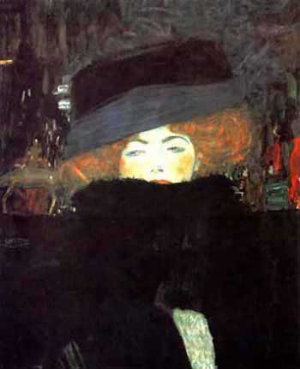
Standing there I suddenly remembered a postcard I used to have taped to the wall near the desk in my childhood bedroom. It was another Klimt image, one that I had not thought about in a long time. In Lady with Hat and Feather Boa a woman with flamboyant curly hair and pale skin gazes demurely out from under a black fur hat, a dark scarf wrapped around her neck. She looked to me like she was going somewhere; the tilt of her eyes implied she was perhaps hiding something. I liked that, I remember, because I often wanted to be going somewhere myself, wishing I had something to hide behind my own eyes. And so I taped her up on the wall; I liked to think that she was watching me.
Lost in my thoughts, I jumped when my mom tapped me on the shoulder.
“Should we find a place for lunch next?” she asked with a playful little smile. “You’re in charge, Ms. Tour Guide.”
“Sure,” I said. Wracking my brain for nearby restaurants, not very familiar with the restaurants in the ‘Museum Mile’ where we were; I was annoyed (and surprised) with myself that I had not already planned where we were going to eat.
But then it came to me: the sound of clinking china as we had entered the museum, a warm food-smell (yes, I can smell cooking food from a distance!), and something that had piqued my curiosity when I read a little while ago suddenly emerged from a forgotten recess in my brain. There is a place to eat right in the Neue Galerie – Café Sabarsky, a Viennese café right standing under our feet.
We sat at a small, marble-topped table in the corner of the bright dining room. A piano stood off to the side, smartly-dressed waiters with white aprons tied around their wastes carried shiny trays holding steaming cups of coffee, a tall glass cabinet behind me held dark cakes and light strudels.
“They have sausage!” said Charley with an almost boyish delight, looking at the menu in front of him. “This is so exciting. I love German-Austrian food like this; it’s the best!” He immediately launched into an impassioned attempt to persuade my mom to order a sausage dish as well… “so I can taste more than one!” he pleaded. She was not to be convinced, however.
My mom’s family is from Denmark and she grew up loving foods and certain familiar tastes that are relatively foreign to me now. But for her, they immediately bring back memories of her father (whom I never met, but have heard much about his passion for the kitchen – a love of food is genetic, perhaps?). Pickled herring is one. It had been a while, but always a favorite flavor. After all, she told me in a confiding tone, when she lived in New York City in her late-twenties, she subsisted on only three food groups: pickled herring, cherry vanilla yogurt, and ring-dings. This confession left me shocked into momentary silence (not all food preferences are genetic, I hope?).
But my mom let Charley enjoy his pale-white Bavarian sausage with potato salad on his own, while she ordered an open faced Matjes Herring sandwich with egg, apple, and topped with thin slices of red onion.
“This is my father,” she said, multiple times, smiling as she ate. “It reminds me so much of him…”
“This reminds me of my father, too,” said Charley, gesturing at the unadorned sausages on his plate. My mom started giggling, raising her eyebrows. She's a psychoanalyst; Charley rolled his eyes. “Oh and what would your colleagues have to say about that?” he asked, laughing. I put my hands over my eyes and groaned, lamenting the sense of humor brought out with a bottle of lunch-time red wine and the insuing conversation about certain elements of Viennese cuisine.
I concentrated on my food: a squash soup – thick and vibrantly orange, topped with the crunch of green toasted pumpkin seeds – and a beautiful salad with greens, cornichons and radishes, dressed with a pumpkinseed oil vinaigrette. Charley’s chestnut soup “Viennese Melange” with Armagnac prunes was rich and sweetly nutty.
For dessert we had a Sachertorte and three forks. The sweet, dark chocolate cake with apricot confiture is a classic Viennese dessert and came with a puffy cloud of whipped cream.
We left full, warm, and a little bit tipsy. It was the perfect state to be in on a beautiful weekend afternoon in New York. Art and food each have the ability to bring back such strong sensory memories; I love experiences when they combine. And after ours, we were ready to face the cold and continue on our artistic expedition.
Saturday, January 27, 2007
Flaming Duck Fat
When Ben threw the bulbous lump of white duck fat into the sauté pan there was a pop, a sizzle, and a burst of orange flame.
He stood back for a moment and watched, a little smile playing on his lips.
“BEN!” bellowed his girlfriend from across the room, an audible note of panic. “It’s on fire!”
She stood next to me in the center of the kitchen and we stared at the flaming pan. I never knew rendering duck fat could be so thrilling.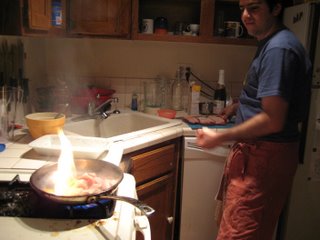
“I don’t feel comfortable with this,” she said.
Ben’s orange apron was tied akimbo around his waste; flour dusted his navy blue T-shirt. “Ok, ok,” he said, “I’ll turn it down.” With a crank of the knob the flame soon disappeared, and we were left only with a melting puddle of duck fat – the crisp left-over brown bits (“duck cracklin’s!” he exclaimed) floated in the bronze-tinted liquid.
We were in the middle of an afternoon of cooking. An afternoon that extended into an evening—what felt like the shortest seven hours I’ve ever spent in a kitchen—and resulted in one of the most exciting, interesting dinner parties in which I’ve taken part.
I have been running around like crazy in the past few months—a heady combination of work and play—and a day in the kitchen was just what I needed.
(Thank you, on a side note, to those who emailed to see if I have been OK. I’ve been a negligent blogger, but things have finally calmed down—grad school application finished!—and I’ll now have more time for my own writing. Already I am sitting on a backlog of cooking experiences to relate… improvised chocolate cake, a dinner party centered around Hungarian paprika, a return to baking my ‘famous’ apple pie.)
But I digress. Flaming duck fat was just a moment in this cooking extravaganza embarked upon with my friend Ben, as we did a run-through of a menu we have been talking about for a long time. We are in the process of planning a small “restaurant” gig—dinner for 10 or 15 people sometime in the near future, with a minimal charge and a deluge of seasonal small plates at Ben’s apartment in Brooklyn.
Ben is an extremely talented, self-taught chef who sidelines as a writer and teacher, and is known for his intricate, creative cooking. At many a Sunday evening dinner get-together I have seen jaws drop in awe as his creations are deposited on the kitchen table in the bright, cozy apartment he shares with his girlfriend.
For our current project Ben is Chef. I don’t have a whole lot of insight to bring to his already wonderful savory creations—unless, that is, you count a very dedicated hand at chopping shallots or cucumbers, slicing kumquats or squeezing the juice out of blood oranges. Which is why I am Pastry Chef. Especially without a full sense of smell (necessary in the constant tasting and experimentation of a savory chef) the science and calculation of baking is where I excel. The loss of my sense of smell (which I have written extensively about) has given me a new sense of the oven—one that relies on measurement, texture, and the visual rather than scent and the intricacies of taste. And, if I do say so myself, I bake beautifully.
A dusky, cold evening last weekend Ben and I brought our menu into existence for a few friends, charged only with a promise to give constructive criticism.
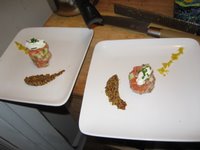
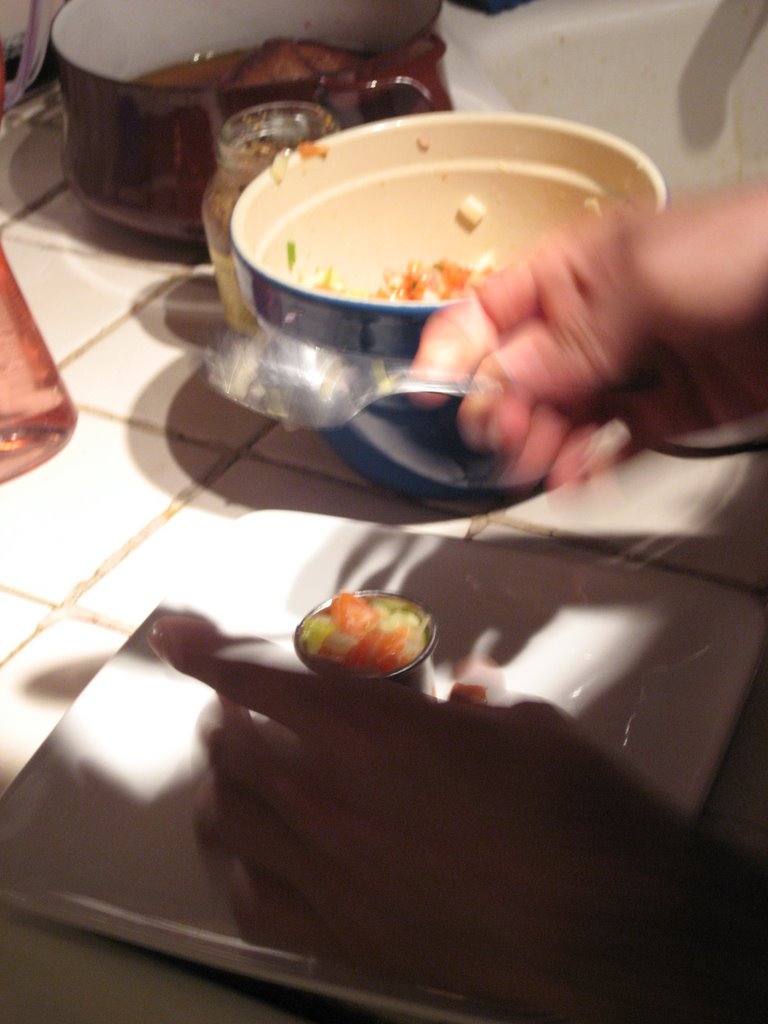
Dinner began with a tartar: stacks of vibrant pink salmon, streaked with soft lines of white, was combined with the green crunch of apples, endive and cucumber. Topped with a cool drop of sour cream and a sprinkling of chives and surrounded with streaming lines of lemon zest and grainy mustard, it was combined by the diner’s fork.
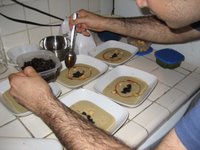 A bronzed cauliflower soup steamed and burbled on the stove before it was plated with a dollop of sweet and sour raisins, a stream of green fennel oil and toasted macadamia nuts. “Oh wow,” said my friend Adrienne as she ate, “this is damn good.”
Next was a saffron risotto – a burnt-orange hue, it was laced with cheese, butter, the nutty and surprising hint of soy milk. It was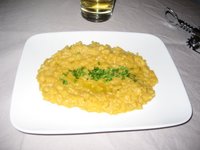 rich and soft, punctured with the green of cut chives, but “there is something off,” said Ben, forever the perfectionist. “It’s not incredibly interesting… Perhaps a combination of two risottos for the final,” he mused. “Blueberry risotto. Maybe mushroom.”
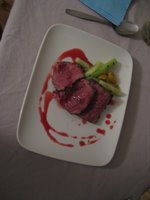 The duck breasts, which we had seared earlier in the evening and let sit in their (once flaming) rendered fat until just before service, were tender. We cut them into delicate, moist slices and served them next to a small salad of cucumber and candied kumquat, drizzled with a vibrant blood orange glaze. “Nothing makes a great duck like a few hours hanging out in its own fat,” said Ben.
It was a half hour later—after a few deep breathes of digestion and the requisite “I can’t believe tomorrow is Monday and I have to go back to work” speak—that the timer rang and I removed my finale from the oven.
Individual molten chocolate cakes, baked in small globular soufflé cups, were nestled on plates next to blue china spoons that held a rounded scoop of light brown ice cream. Salted Caramel Ice Cream: quite possibly the most delicious thing on the face of the earth with its cool, understated sweetness and a backhand tang of salt. Molly of Orangette first clued me into its existence, and with her recipe, my ice cream maker, and a sprinkling of fleur de sel on top, it complimented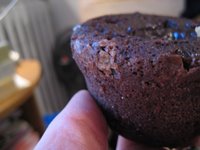 the cake perfectly. Salty to sweet; hot to cold. There was silence around the table as our spoons clinked in unison.
(The only picture I have was taken the next day, with one of the leftovers, as I was too distracted with the act of eating to use my camera at the time...)
I’m not sure exactly when Ben's and my “restaurant” will come to pass – recipes need tweaking, tables need renting, details need finessing (if anyone has any tips, ideas, or interest in joining us, please email me). The act of creation itself, however, has been an inspiring challenge. And, to echo Adrienne, “pretty damn delicious.”
The dinner party resulted in a late night and the streets were dark and empty as I walked from the subway to my apartment, a scarf wrapped around my face and the a bite of wind hinting that this late winter freeze may indeed arrive. I felt full and tired, yet buoyed up with the knowledge that I can still cook. The kitchen still beckons. There are happy culinary projects looming.
***
I was sleepy the next day when, perched at my desk, I tried to make sense of the words winking at me from my computer. It was not long, however, before the Tupperware container holding a small left-over cake popped right out of my bag (10am is prime dessert time, I say). Combined with a very large coffee, I've discovered, individual molten chocolate cakes can make the trying times of an office on a Monday morning shockingly pleasant.
He stood back for a moment and watched, a little smile playing on his lips.
“BEN!” bellowed his girlfriend from across the room, an audible note of panic. “It’s on fire!”
She stood next to me in the center of the kitchen and we stared at the flaming pan. I never knew rendering duck fat could be so thrilling.
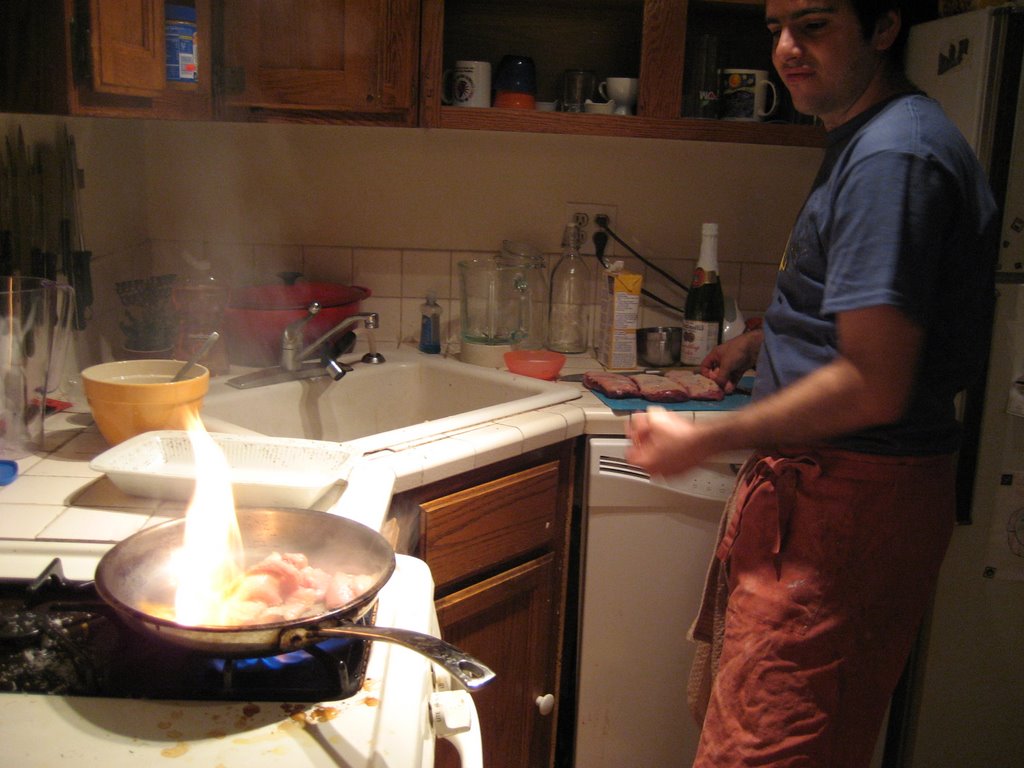
“I don’t feel comfortable with this,” she said.
Ben’s orange apron was tied akimbo around his waste; flour dusted his navy blue T-shirt. “Ok, ok,” he said, “I’ll turn it down.” With a crank of the knob the flame soon disappeared, and we were left only with a melting puddle of duck fat – the crisp left-over brown bits (“duck cracklin’s!” he exclaimed) floated in the bronze-tinted liquid.
We were in the middle of an afternoon of cooking. An afternoon that extended into an evening—what felt like the shortest seven hours I’ve ever spent in a kitchen—and resulted in one of the most exciting, interesting dinner parties in which I’ve taken part.
I have been running around like crazy in the past few months—a heady combination of work and play—and a day in the kitchen was just what I needed.
(Thank you, on a side note, to those who emailed to see if I have been OK. I’ve been a negligent blogger, but things have finally calmed down—grad school application finished!—and I’ll now have more time for my own writing. Already I am sitting on a backlog of cooking experiences to relate… improvised chocolate cake, a dinner party centered around Hungarian paprika, a return to baking my ‘famous’ apple pie.)
But I digress. Flaming duck fat was just a moment in this cooking extravaganza embarked upon with my friend Ben, as we did a run-through of a menu we have been talking about for a long time. We are in the process of planning a small “restaurant” gig—dinner for 10 or 15 people sometime in the near future, with a minimal charge and a deluge of seasonal small plates at Ben’s apartment in Brooklyn.
Ben is an extremely talented, self-taught chef who sidelines as a writer and teacher, and is known for his intricate, creative cooking. At many a Sunday evening dinner get-together I have seen jaws drop in awe as his creations are deposited on the kitchen table in the bright, cozy apartment he shares with his girlfriend.
For our current project Ben is Chef. I don’t have a whole lot of insight to bring to his already wonderful savory creations—unless, that is, you count a very dedicated hand at chopping shallots or cucumbers, slicing kumquats or squeezing the juice out of blood oranges. Which is why I am Pastry Chef. Especially without a full sense of smell (necessary in the constant tasting and experimentation of a savory chef) the science and calculation of baking is where I excel. The loss of my sense of smell (which I have written extensively about) has given me a new sense of the oven—one that relies on measurement, texture, and the visual rather than scent and the intricacies of taste. And, if I do say so myself, I bake beautifully.
A dusky, cold evening last weekend Ben and I brought our menu into existence for a few friends, charged only with a promise to give constructive criticism.

Dinner began with a tartar: stacks of vibrant pink salmon, streaked with soft lines of white, was combined with the green crunch of apples, endive and cucumber. Topped with a cool drop of sour cream and a sprinkling of chives and surrounded with streaming lines of lemon zest and grainy mustard, it was combined by the diner’s fork.
 A bronzed cauliflower soup steamed and burbled on the stove before it was plated with a dollop of sweet and sour raisins, a stream of green fennel oil and toasted macadamia nuts. “Oh wow,” said my friend Adrienne as she ate, “this is damn good.”
Next was a saffron risotto – a burnt-orange hue, it was laced with cheese, butter, the nutty and surprising hint of soy milk. It was
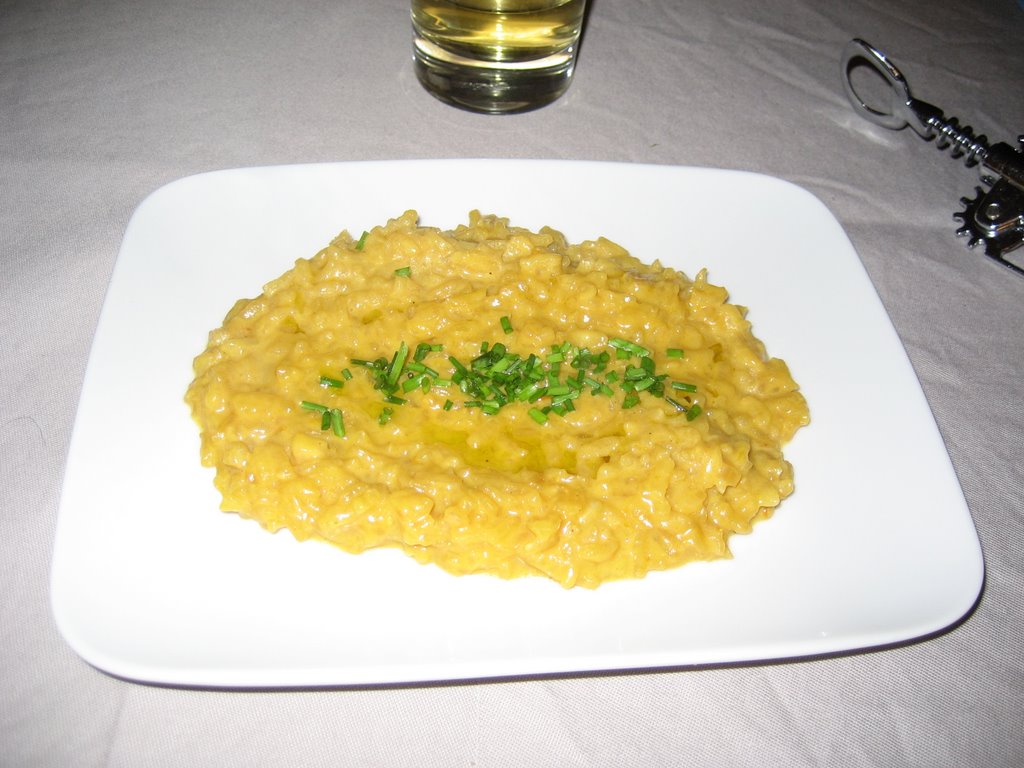 rich and soft, punctured with the green of cut chives, but “there is something off,” said Ben, forever the perfectionist. “It’s not incredibly interesting… Perhaps a combination of two risottos for the final,” he mused. “Blueberry risotto. Maybe mushroom.”
 The duck breasts, which we had seared earlier in the evening and let sit in their (once flaming) rendered fat until just before service, were tender. We cut them into delicate, moist slices and served them next to a small salad of cucumber and candied kumquat, drizzled with a vibrant blood orange glaze. “Nothing makes a great duck like a few hours hanging out in its own fat,” said Ben.
It was a half hour later—after a few deep breathes of digestion and the requisite “I can’t believe tomorrow is Monday and I have to go back to work” speak—that the timer rang and I removed my finale from the oven.
Individual molten chocolate cakes, baked in small globular soufflé cups, were nestled on plates next to blue china spoons that held a rounded scoop of light brown ice cream. Salted Caramel Ice Cream: quite possibly the most delicious thing on the face of the earth with its cool, understated sweetness and a backhand tang of salt. Molly of Orangette first clued me into its existence, and with her recipe, my ice cream maker, and a sprinkling of fleur de sel on top, it complimented
 the cake perfectly. Salty to sweet; hot to cold. There was silence around the table as our spoons clinked in unison.
(The only picture I have was taken the next day, with one of the leftovers, as I was too distracted with the act of eating to use my camera at the time...)
I’m not sure exactly when Ben's and my “restaurant” will come to pass – recipes need tweaking, tables need renting, details need finessing (if anyone has any tips, ideas, or interest in joining us, please email me). The act of creation itself, however, has been an inspiring challenge. And, to echo Adrienne, “pretty damn delicious.”
The dinner party resulted in a late night and the streets were dark and empty as I walked from the subway to my apartment, a scarf wrapped around my face and the a bite of wind hinting that this late winter freeze may indeed arrive. I felt full and tired, yet buoyed up with the knowledge that I can still cook. The kitchen still beckons. There are happy culinary projects looming.
***
I was sleepy the next day when, perched at my desk, I tried to make sense of the words winking at me from my computer. It was not long, however, before the Tupperware container holding a small left-over cake popped right out of my bag (10am is prime dessert time, I say). Combined with a very large coffee, I've discovered, individual molten chocolate cakes can make the trying times of an office on a Monday morning shockingly pleasant.
Subscribe to:
Posts (Atom)

