My grandfather Morris didn’t sleep at night. He would stay up until dawn, filling the dark with books and television. He was an artist as well as businessman, and would spend time painting in his studio—oil on canvas until his 80s, when arthritis overtook his fingers and he taught himself to make art on his computer. And towards the end of his life, when he was confined to a wheelchair, he would talk with Joel, a soft-spoken man from Peru who was hired to help.
I met Joel for the first time on Monday of this week, when he stood at the bima of an earth-colored synagogue to give a eulogy at my grandfather’s funeral. His English was hesitant; he had spoken only Spanish until he began these late-night talks with Morris.
There were a few things my grandfather had taught him during their hours together, he explained. First, Joel said with a laugh, he had learned to eat and appreciate smoked salmon during those nights with the 93-year-old man. He learned to watch baseball, especially the Yankees. He learned that his wife is boss of the home. He learned to say I love you.
There was smoked salmon at the gathering in my grandparent’s house after the funeral. I looked at it, sitting on a plastic platter next to the bagels on a table piled with food, but couldn’t remember my grandfather ever eating it. I can't remember much of what he ate at all; there are only a few things that stand out.
I remember the salt—he used a lot, on everything. I remember the gefilte fish—I was entranced by the gray blob his plate during childhood Passover Seders. My family always brought an offering of dried apricots when we visited. Strange bottles of alcohol stood like one of his still-life paintings in the dining room there. And there was always that china container of M&Ms on the counter, waiting to be raided by me and my brother.
I only spent 48 hours in upstate New York before hopping on a plane to come back west. It’s all a fog now, punctuated with scenes of suits and nice shoes, dining room tables and my aunt’s tiny dogs, noodle kugel and roast chicken.
I didn’t have a chance to process anything—the funeral, my grandfather—until I returned home to California. I thought about it all for a while last night, while baking bread. There’s something comforting about the act of kneading. The rhythmic, constant movement relaxes me. Around dusk yesterday evening my kitchen counter was strewn with bowls and wooden spoons, bread pans and thermometers. The flour, which flew around the room as I wrestled with dough, reminded me of the smoke rising off the land around me, remnants of California’s current fires.
My grandfather, a man large in both personality and girth, was a powerful force in my family. Like with the dough, I suppose I’ll always wrestle with my memories of him. Patience is key. It all needs time to rise.
Friday, June 27, 2008
Wednesday, June 25, 2008
How it all began
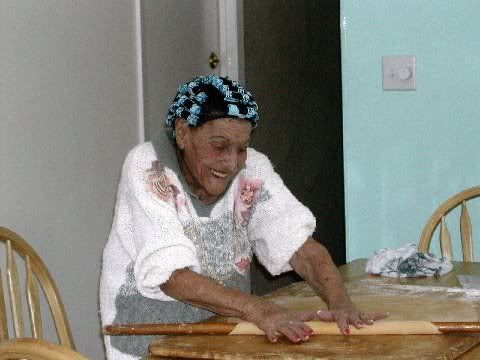
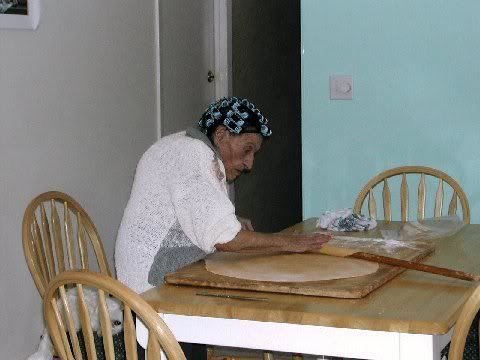
When I think back as far as I can remember to some of my first food memories my grandmother is always there. Well she was there all the time, she lived with us my whole life. She was a part of that house on East 22nd street. When I think of that home, I think of her. When I was just a child maybe around 7 years old, I can remember making pasta with nanny. She made manicotti, ravioli, cavatelli and taglioline all from the same dough. She didn't make crepes in a pan on the stove, her manicotti were rolled out so thin you could see through it...just as thin as a crepe. The dough was made with the well method. A big pile of flour, eggs and water. It amazed me how it all came together. She had a big wooden board which she layed out on her dining room table and a long skinny rolling pin. It's not like the ones that you see Chef's use on tv. She rolled that dough until it was paper thin. It seemed to take forever. She let me try to roll it out but I didn't have the strength to really push it hard. Instead I always got my own piece of dough to work with....most of it I ended up eating. You'd be amazed if you saw her work the dough, kneading and rolling and making it slap against the board when she rolled it out. Once it was time to cut the dough she always let me help. She had a ravioli cutter which she used to make the ravioli and manicotti. She let me help with this that was always the fun part. Any mistakes were forgiven and the strips were cut off and put aside for later. She also let me help with the ricotta filling...again, half the mozzarella ended up in my mouth! After they were made we put them in the freezer to harden and then put them in bags and went back in the freezer. The best part were the strips we put aside. Those were what she called Taglioline. With this she made us lunch. She used it as noodles for soup or she made a quick thin sauce and we ate it like fettucine. It was the greatest thing I ever ate. I could still taste it. It saddens me that I never really learned how to make Nanny's fresh pasta. She didn't measure and it was so hard to do. I've tried making pasta in my kitchen aid stand mixer. Not bad. Not like Nanny's but still I know she would be proud.
Saturday, June 14, 2008
California
After graduation Matt and I drove across the country - a trip filled with bumpy back roads and gas-station coffee, crawfish gumbo and BBQ pork, wrinkled maps and unfamiliar accents. There was the humidity of Louisiana's bayou, the deep-red sand of Arizona's canyon, and the rhythmic movement of oil pumpjacks spanning the Texas landscape. We arrived in northern California last week, just in time for me to begin my new job and Matt to hop on a plane and begin his own. Though the change is disarming, it's good. My new home smells like eucalyptus and the ocean. There are farmer's markets, dairy farms, and bread dough already rising on my counter. More soon...


Monday, April 28, 2008
Plans
I cooked dinner the other night for Matt and I, in the kitchen of his small New York studio apartment. The meal had definite potential: a roast chicken with cherry tomatoes, garbanzo beans and paprika. The garlic, seeped with olive oil and red pepper flakes, filled the room with its warmth as it baked.
But something—and I still don’t know what—went wrong. A frustrating hour and a half later, I slid the entire contents of the roasting pan into the trash. Rubbery, undercooked chicken had slouched next to a blackened, asphyxiated pile of beans and tomatoes. Grease flowed off the pan. It was my first experience with such surprising inedibility.
I’ve been feeling anxious lately, because graduate school is reaching its end and I’m moving to California in less than a month. My apartment is a mess and deadlines refuse to stop hanging over my head. I'm allergic to everything this time of year, which makes it difficult to breathe, let alone smell. Usually my stress manifests itself in small ways: forgetting my wallet, milk in the cupboard and cereal in the fridge. Occasionally bigger ways: picking fights with my mother on the phone, deciding to cut off half my head of hair. But my anxiety had never yet entered the kitchen.
I made a half-hearted attempt to carve the sad little chicken while Matt chuckled off to the side. I was frustrated and, true to form, began to pick a fight. I like when things to according to plan. The thump as it all hit the bottom of the garbage bin was satisfying.
Luckily, Matt is patient. We resuscitated the evening with the asparagus I had picked up from the farmer's market that morning - simply roasted with olive oil, salt, and pepper. I made toast and Matt pulled out a delightful container of foie gras that he had brought back from France over a year ago.
"I was saving it for a special occasion," he said, prying open the thick sealed lid with a knife.
We sat around his small coffee table, perched on a desk chair and a corner of the bed. We drank red wine and plucked asparagus stalks off the plate with out fingers. Sometimes, I suppose, things are OK when they don't go according to plan.
But something—and I still don’t know what—went wrong. A frustrating hour and a half later, I slid the entire contents of the roasting pan into the trash. Rubbery, undercooked chicken had slouched next to a blackened, asphyxiated pile of beans and tomatoes. Grease flowed off the pan. It was my first experience with such surprising inedibility.
I’ve been feeling anxious lately, because graduate school is reaching its end and I’m moving to California in less than a month. My apartment is a mess and deadlines refuse to stop hanging over my head. I'm allergic to everything this time of year, which makes it difficult to breathe, let alone smell. Usually my stress manifests itself in small ways: forgetting my wallet, milk in the cupboard and cereal in the fridge. Occasionally bigger ways: picking fights with my mother on the phone, deciding to cut off half my head of hair. But my anxiety had never yet entered the kitchen.
I made a half-hearted attempt to carve the sad little chicken while Matt chuckled off to the side. I was frustrated and, true to form, began to pick a fight. I like when things to according to plan. The thump as it all hit the bottom of the garbage bin was satisfying.
Luckily, Matt is patient. We resuscitated the evening with the asparagus I had picked up from the farmer's market that morning - simply roasted with olive oil, salt, and pepper. I made toast and Matt pulled out a delightful container of foie gras that he had brought back from France over a year ago.
"I was saving it for a special occasion," he said, prying open the thick sealed lid with a knife.
We sat around his small coffee table, perched on a desk chair and a corner of the bed. We drank red wine and plucked asparagus stalks off the plate with out fingers. Sometimes, I suppose, things are OK when they don't go according to plan.
Tuesday, April 22, 2008
Stories
I've been talking about scent a lot in the past few weeks. New smells, which continue to come back at an increasingly rapid pace, are exciting. I didn't think I could ever completely forget the scent of spring, but now it hits me when I walk out of my apartment and I am surprised anew by the depth of flower and grass. I spoke to an editor at my alma matter's alumni magazine about a new book, The Scent of Desire, and Dick Gordon, the host of American Public Media's The Story, interviewed me last week.
Here is just a short list of my favorite smell-related essays that I've written here, to help orient anyone new:
When I worked as a dishwasher:
Sardines and Frying Pans
Surprise Encounter
When I lost my sense of smell:
Unexpected Changes
Kind of Blue
Living without scent:
Bittersweet
Rosemary and James Bond
Recovering:
Holding My Nose
Evening, New York
Here is just a short list of my favorite smell-related essays that I've written here, to help orient anyone new:
When I worked as a dishwasher:
Sardines and Frying Pans
Surprise Encounter
When I lost my sense of smell:
Unexpected Changes
Kind of Blue
Living without scent:
Bittersweet
Rosemary and James Bond
Recovering:
Holding My Nose
Evening, New York
Tuesday, April 15, 2008
Change
My family came to the city this past weekend. My mother and her boyfriend Charley, my brother Ben and his girlfriend Ashley, and Matt and I went to Annisa, an American-eclectic eatery in Manhattan’s West Village.
I’ve spent the last six months or so writing about Anita Lo, the chef there, for my Master’s thesis on gender in the professional kitchen. It was odd to sit in the chic cushioned booth of her restaurant, surrounded by the chatter of family and clink of silverware. I was suddenly an intimate part of a scene I had recently spent late nights pondering over a Word document and my laptop.
And the food took on a different persona when placed delicately down in front of me on a wide white plate instead of just a bite, quickly handed over on a battered spoon in a corner of the sweaty kitchen. The elegance of the dining room was charming, but I missed the character that came when eating with the heat and gurgle of a deep fryer half a foot away.
But out at the table, everyone agreed, the soup dumplings topped with foie gras were especially magnificent. The line cooks, I remembered, threw them frozen with a hunk of butter into a steamer to create their delicate liquid center. The goat cheesecake was soft and rich, with a perfect sour twang. The thin slices of candied beets served underneath had entranced me since February, when I helped plate desserts one evening, my reporters notebook tucked in my back pocket.
Mainly, though, it felt nice to have my family together. I recently accepted a job in California, to write for a weekly paper near San Francisco. I’ll be away from the East Coast for at least a year; it will be a while before we are all together again.
I’m going to miss New York, with its nooks and crannys, faces and melodies, perfumes and stenches. But there’s a lot going for the change. Without a doubt, I’ll have more time to write.
I’ve spent the last six months or so writing about Anita Lo, the chef there, for my Master’s thesis on gender in the professional kitchen. It was odd to sit in the chic cushioned booth of her restaurant, surrounded by the chatter of family and clink of silverware. I was suddenly an intimate part of a scene I had recently spent late nights pondering over a Word document and my laptop.
And the food took on a different persona when placed delicately down in front of me on a wide white plate instead of just a bite, quickly handed over on a battered spoon in a corner of the sweaty kitchen. The elegance of the dining room was charming, but I missed the character that came when eating with the heat and gurgle of a deep fryer half a foot away.
But out at the table, everyone agreed, the soup dumplings topped with foie gras were especially magnificent. The line cooks, I remembered, threw them frozen with a hunk of butter into a steamer to create their delicate liquid center. The goat cheesecake was soft and rich, with a perfect sour twang. The thin slices of candied beets served underneath had entranced me since February, when I helped plate desserts one evening, my reporters notebook tucked in my back pocket.
Mainly, though, it felt nice to have my family together. I recently accepted a job in California, to write for a weekly paper near San Francisco. I’ll be away from the East Coast for at least a year; it will be a while before we are all together again.
I’m going to miss New York, with its nooks and crannys, faces and melodies, perfumes and stenches. But there’s a lot going for the change. Without a doubt, I’ll have more time to write.
Wednesday, March 19, 2008
Break
They sky was still dark as Matt and I rode our bikes to Penn Station early on Monday morning. I watched the sun slowly rise over the Hudson while we pedaled down Riverside Park. The industrial buildings across the river looked soft in the trickle of early light. I wore a thin pair of black-and-red gloves that my mother gave me years ago; my fingers were numb by the time we hauled our bikes down the stairs that led to the Long Island Railroad.
Technically we are on “spring break” from graduate school, where both Matt and I are studying journalism. Unfortunately, as you’ve seen from my lack of activity here, there is very little break involved in a 10-month master’s program, no matter what the season. Thirty-six hours in Long Island would have to do it.
We arrived in East Hampton around 11 a.m., dropped our bags off at the Inn, and began to explore. It didn’t matter that the grass was brown and the trees gray. The windmill standing on a grassy plain off of Main Street was crisp against the cloudless blue sky.
The wind pushed against my puffy down jacket as we rode down Further Lane and gawked at the mansions overlooking the water. We parked our bikes and walked along the beach. I could smell the ocean. It was thick and salty.
That night, my face warm with the day’s resulting windburn, we went out to dinner at a nearby restaurant—which, I thought happily as we walked down the empty street, was probably the equivalent of 4 Manhattan-length blocks from our Inn. Then I realized that I was thinking in terms of Manhattan-length blocks, which disturbed me. As did my unfamiliarity with the sky’s blackness, as I’m so used to New York City’s perpetual light. Birds had been chirping all day; a stark contrast to the ambulance sirens and subway trains usually grinding in my eardrums. It’s been too long since I’ve taken a break, I thought.
We sat at a side table in the dining room of Della Femina, a graceful Italian joint filled with flickering candles and beige tablecloths. The food arrived on our table in unassuming combinations of the familiar yet interesting. A curried carrot soup with golden raisins, lime crème fraiche, and a drizzle of a spicy oil. Seared salmon with lemongrass syrup. Matt’s warm croissant bread pudding with white chocolate mousse disappeared quickly.
The meal meandered in a slow, even tempo. The simple act of sitting, sipping wine, and talking about subjects far from graduate school was delicious.
And now, back in the city, I am avoiding the Word document that holds the final draft of my master’s project. I am attempting to tune out the rocking bass of what I can only assume is my next-door neighbor’s perpetual dance party. It has been raining all day and I can smell its wetness, soaked into the brick outside my window. It’s thin and musty, very different from the ocean.

Technically we are on “spring break” from graduate school, where both Matt and I are studying journalism. Unfortunately, as you’ve seen from my lack of activity here, there is very little break involved in a 10-month master’s program, no matter what the season. Thirty-six hours in Long Island would have to do it.
We arrived in East Hampton around 11 a.m., dropped our bags off at the Inn, and began to explore. It didn’t matter that the grass was brown and the trees gray. The windmill standing on a grassy plain off of Main Street was crisp against the cloudless blue sky.
The wind pushed against my puffy down jacket as we rode down Further Lane and gawked at the mansions overlooking the water. We parked our bikes and walked along the beach. I could smell the ocean. It was thick and salty.
That night, my face warm with the day’s resulting windburn, we went out to dinner at a nearby restaurant—which, I thought happily as we walked down the empty street, was probably the equivalent of 4 Manhattan-length blocks from our Inn. Then I realized that I was thinking in terms of Manhattan-length blocks, which disturbed me. As did my unfamiliarity with the sky’s blackness, as I’m so used to New York City’s perpetual light. Birds had been chirping all day; a stark contrast to the ambulance sirens and subway trains usually grinding in my eardrums. It’s been too long since I’ve taken a break, I thought.
We sat at a side table in the dining room of Della Femina, a graceful Italian joint filled with flickering candles and beige tablecloths. The food arrived on our table in unassuming combinations of the familiar yet interesting. A curried carrot soup with golden raisins, lime crème fraiche, and a drizzle of a spicy oil. Seared salmon with lemongrass syrup. Matt’s warm croissant bread pudding with white chocolate mousse disappeared quickly.
The meal meandered in a slow, even tempo. The simple act of sitting, sipping wine, and talking about subjects far from graduate school was delicious.
And now, back in the city, I am avoiding the Word document that holds the final draft of my master’s project. I am attempting to tune out the rocking bass of what I can only assume is my next-door neighbor’s perpetual dance party. It has been raining all day and I can smell its wetness, soaked into the brick outside my window. It’s thin and musty, very different from the ocean.

Subscribe to:
Posts (Atom)

