Sunday, October 15, 2006

Fall for Osso Buco

There was a cool bite to the air when I walked through Prospect Park on my way to the farmer's market yesterday. The bronze afternoon sunlight fell at a slanted angle, an implication of early darkness. Bright sugar pumpkins and a collection of gnarly gourds were scattered amongst the market's booths of apples and pears, beets and squash. People were wearing scarves and sipping steaming cups of hot cider.

It snuck up on me, but, apparently, it's fall.

There were moments this summer, as I stewed in the claustrophobic heat of my top-floor, un-air-conditioned apartment, when I was positive that fall would never come. I was destined to roast myself into sweaty oblivion forever. How lucky that things change. Sweaters have come out, blankets piled back onto my bed, clunking acorns drop constantly on my fire escape. And it is time to start bringing cold weather cooking back into my repertoire.

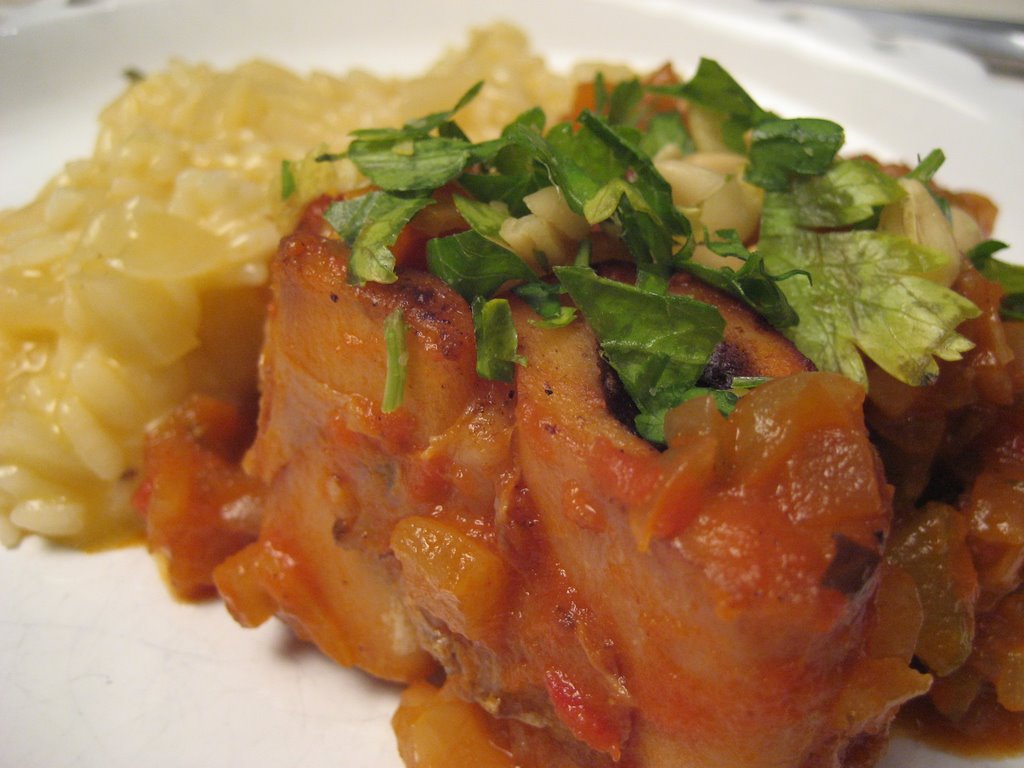
Last night, snug in my friend John’s beautiful kitchen, we concocted a magnificent osso buco. The rustic braised veal stew – meltingly tender and full of flavor, topped with a parsley pine-nut gremolata, side-by-side with the traditional Italian accompaniment of a creamy risotto – was the perfect way to inaugurate fall.


Inspired by Mario Batali, the recipe was surprisingly easy. A hefty tomato sauce simmered on the stove as we chopped the onions, carrots, celery and fresh thyme. The veal shanks plopped in a hot pan of olive oil to brown with a dramatic sizzle. Within thirty minutes the osso buco was in the oven, left alone for two and half fragrant hours.

John and I just had to sit back and wait. We watched a movie (something violent with John Cusack, of which I was not a fan), sipped some wine (left over from the cooking), pondered the pros and cons of Leonardo DiCaprio (shockingly good in The Departed, I thought) and the merits and pitfalls of grad-school (is it worth it?).

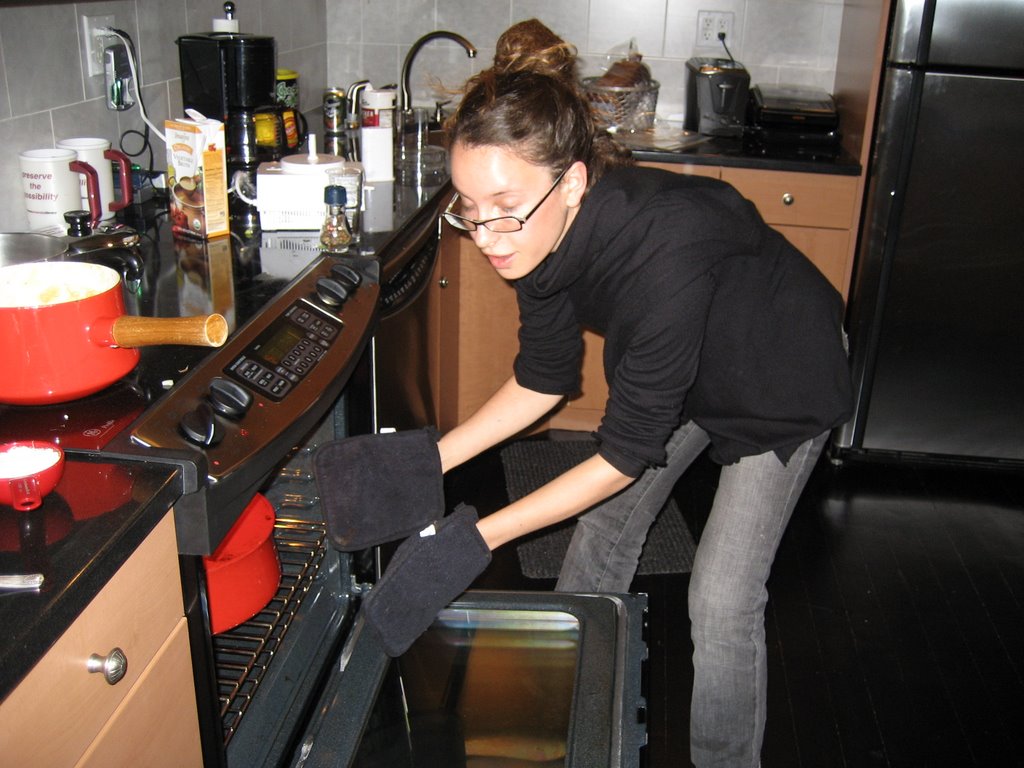
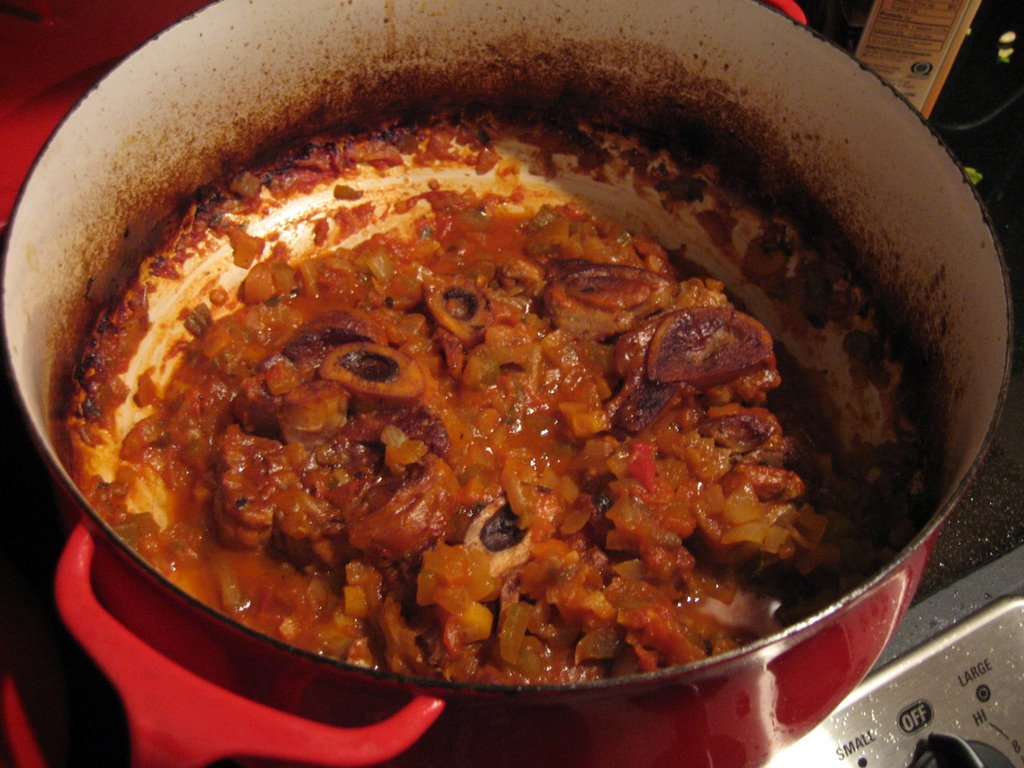
I eventually removed myself from the couch to stir a leisurely pot of risotto. John’s skills as a Cuisinart master were proven solid when he pulsed together the gremolata garnish. And when I lugged the big pot out of the oven and opened the lid, I was surprised at the ease with which it all came together. (See -- don't I look about to be surprised in that photo?) It is very satisfying to make such a great meal with so little trouble.

The meat was falling off the bone, a beautiful braise. The risotto was just a bit al dente, the perfect textural foil to the stew. The pine nuts in the gremolata were a necessary crunch; the green of the parsley and yellow of the lemon zest rounded out the color palette.

Fall is coming along quite nicely.


Osso Buco with Pine Nut Gremolata
Inspired by Mario Batali's Molto Italiano


4 3-inch-thick osso buco
salt and pepper
6 tablespoons olive oil
1 carrot, sliced into rounds
1 spanish onion, chopped
1 rib celery, diced
2 tablespoons fresh thyme, chopped
2 cups tomato sauce (recipe below)
2 cups chicken stock
2 cups dry white wine

1/2 cup chopped parsley
1/4 cup toasted pine nuts
zest of one lemon, grated

-preheat oven to 375
-season osso buco with salt and pepper on both sides.
-in a large dutch oven, brown the osso buco in olive oil (the oil should be hot to the point of smoking), on all sides, about 12-15 minutes, and then remove from the pan.
-add carrot, onion, celery, and thyme to the pot and stir for about 10 minutes, until the vegetables are softened.
-add tomato sauce, stock and wine. bring to boil and then place the osso buco back in the pot.
-cover the pot tightly and put into the oven, for 2 to 2 1/2 hours. (the meat will be falling off the bone.)

-make gremolata: mix parsley, pine nuts and lemon zest. give it a few pulses in food processor. sprinkle on top of the osso buco when serving.


Tomato Sauce

1/4 cup olive oil
1 spanish onion, chopped
4 cloves garlic, thinly sliced
3 tablespoons fresh thyme, chopped
1 carrot, chopped
2 28-oz cans whole tomatoes
salt

-heat olive oil, add onion and garlic and cook, stirring, for 8-10 minutes. add thyme and carrot, cook five minutes.
-add tomatoes and bring to a boil. stir often. lower heat and simmer until thick, around 30 minutes.


Sunday, October 8, 2006

Distractions

On Saturday night of last week I stood over a large metal pot on the stove, steam fogging my glasses, stirring a bubbling cauldron of soup with a wooden spoon. I was wearing baggy sweatpants and an old T-shirt of my brothers, my hair in a frizzy knot on top of my head. The sound of the Gypsy Kings danced in the background of my apartment. For the first time in what felt like a long time, I was staying in for an evening, by myself. I had switched off both my cell phone and computer. I finally had a moment for the kitchen.

Life has been piling up on me the last few weeks and in my much-needed evening of solitude, I was on a mission for comfort. And so I was concocting a simple chickpea-tomato soup – its muted red color was made vibrant by a hefty flavor. The methodical act of chopping the requisite knotty cloves of garlic and sprigs of fresh rosemary released strong scents, a (relatively new) olfactory pleasure that never fails to lift my mood. There is something very healing about the act of cooking alone, just for myself. The mechanics of stirring and chopping, listening to the crackle of onions in a pan, the sensation of steam on my skin are soothing. The time spent alone, concentrating on the stove and the sink, the washing of vegetables and the slow crank of the can opener clears my head.

And in the end when I sat with a good book, a glass of wine, and the quiet lilt of Bach, the warming soup with a hunk of fresh sourdough bread from the farmers market was just what I needed to feel like myself again.

My mind has been in somewhat of a haze in the past month with reverberations of my accident’s anniversary, ending romances, the unexpected death of a friend. And, as a result, I have not felt inspired to write. Even sitting down at my computer today I spent a long time staring blankly at my keyboard, not sure what, if anything, I wanted to write about. I certainly haven’t been cooking; that soup was my first foray into the kitchen in weeks. The act of going out to eat has been more of a tool for distraction, time spent with friends. But of course, that is sometimes the most meaningful.

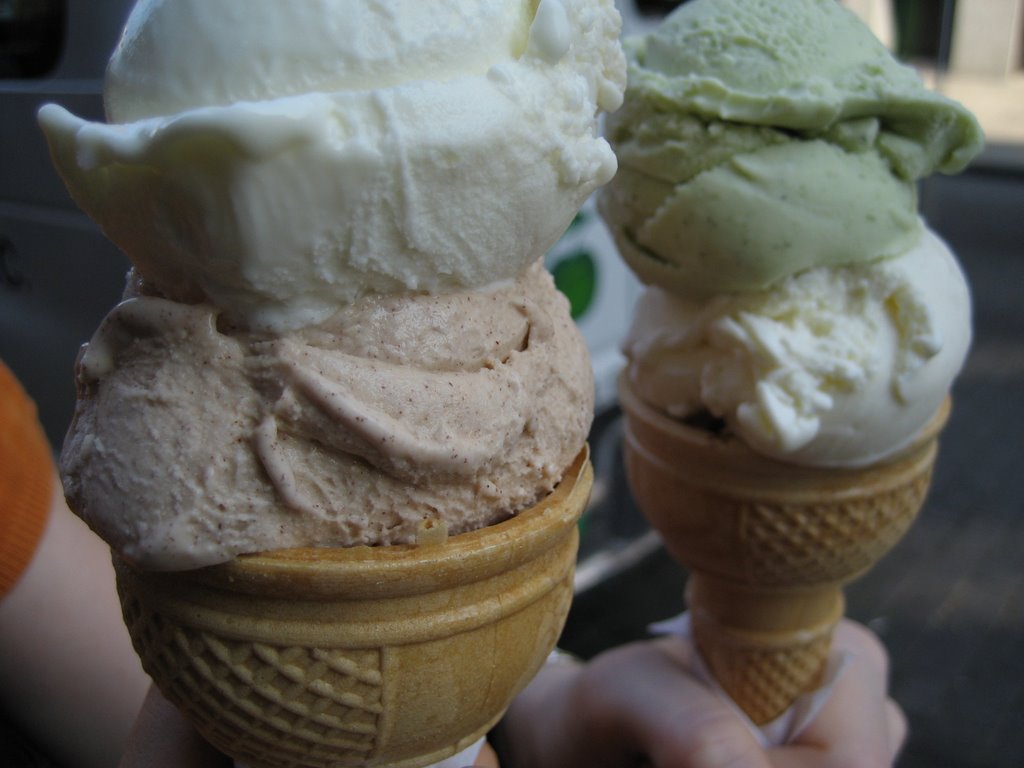
Becca was in New York, unexpectedly, and on a Sunday afternoon we sat in a little French café just a few blocks from my apartment in Park Slope. The end-of-summer light was bright, streaming in the large front window and illuminating our glasses of water on the table. There was a young couple to our left, dressed in stylishly mismatched clothing and chatting with the chef who was obviously a friend. The woman behind the counter drank coffee from a big white mug; flaky brown croissants winked at us from behind the glass. We had spent the morning walking through the nether-regions of Prospect Park and were tired, hungry, in need of caffeine. The day before had been emotionally draining, spent at a funeral in New Jersey. It was difficult to put together any coherent words to express how we were feeling. But we sat and ate warm pressed sandwiches with fresh ricotta, oven roasted tomatoes and basil pesto; side-by-side with small, nutty arugula salads. It was comforting to be there, eating together. We later found ourselves in Manhattan and stumbled onto the magnificent Il Laboratorio del Gelato, a small and eclectic ice cream shop on the Lower East Side. We munched on cones of buttermilk, cinnamon, sour cream and fresh mint ice cream. We enthusiastically pondered the existence of such delicious, unusual flavors as we wandered through a wild little pickle festival on Orchard Street, packed with people and uniquely brined things. Our day of culinary distraction was a welcome, rejuvenating respite from all else.

Jon and I, too, have been spanning the boroughs on gourmet expeditions – to a pig roast on the sidewalk in front of Il Buco, fried plantains and empanadas at the Caracas Arepas Bar, spicy pasta puttanesca at a hold-in-the-wall Italian restaurant, quail and coconut pudding at a Brazilian restaurant in Queens. The barbecued chicken and grits in our own neighborhood’s Sadie Mae's was a lengthy and mediocre taste-experience that I would probably not subject myself to again – but the pumpkin ale we brought there from the bodega on the corner was excellent.

The culinary is, obviously, one of my favorite ways to deal with difficult times – but the most meaningful, comforting moment I have had recently involved nothing gourmet.

It happened after seven of my college friends and I stood side-by-side, next to an open grave on a beautiful early-fall morning. It was brisk and sunny; white and red flowers peppered the vibrant green grass in the cemetery surrounding us. The sound of spoken Spanish hardly registered as we listened to the priest; there was only the universal muffle of crying. The red carnation in my hand was cold; the creaking squeal of the coffin as it was lowered into the ground echoed in my fingertips. The eight of us had met our first week of college; the ninth member of that little family was no longer with us.

An hour later we stood together in the wide parking lot of a New Jersey strip mall. The men were in suits, their ties just beginning to loosen around their necks. Becca and I, the only women, were in stark, dark-colored dresses. Many of us had parted ways in the last few years; it was the first time we had all been together in a long time. And we stood together in our fancy, black clothing in a throng of people – men in flip-flops, women in ripped jeans, families with screaming children, gray-haired couples with matching canes – and waited for our names to be called over the loudspeaker. We were waiting for a table at Ihop, The International House of Pancakes. A favorite destination of our friend; we were there together to remember him.

We all squeezed into a booth in the back of the crowded diner and ate soggy pancakes, wilting bacon and coffee poured out of a plastic thermos. I could feel the warmth of the shoulders next to me, the taste of orange juice in my mouth, the slow laughter of my friends as we caught up on days past. And I was struck by the inexplicable fact that we were there, together, and alive. There was something so gut-wrenchingly moving about feeding ourselves together that day. It was the sustenance of companionship and food, together in remembrance of a friend.

Saturday, September 9, 2006

On an Anniversary

“Anniversary syndrome,” my father told me two weeks ago on the phone, “is a very real thing.” I was walking down 6th avenue, just having left work after a long day, and feeling very ungrounded. “It’s been one year since your accident, Molly,” he said, “And your body remembers these things, even if it’s not conscious. Physically, you remember the pain—and mentally, the trauma. Of course this week will be difficult, it’s only natural.”

As soon as the words came out of his mouth I knew that he was right. Images of myself at the moment of impact had been floating consistently around my mind – much more so than usual. Though often hovering somewhere in my close consciousness, thoughts on the accident—when I was hit by a car early on a Tuesday morning, one of the last days of August, 2005—felt impossibly close. I could not step away from thinking about exactly where I was one year ago—lying in a hospital cot, loopy and acting drunk due to my head trauma; later unable to move from the bed we brought into my family room for a few months, so depressed that I could not look anyone in the eye; hyperventilating in pain when my knee was jostled after surgery; my head spinning, dizzy and unable to focus my eyes; realizing that I had lost my sense of smell.

And it is only now, one year later, that the reality of that past situation is hitting me in full force. That was me. That girl—that depressed, shattered girl—that was me. So it makes sense that the week leading up to August 30th was a bad one, plagued with the constant rumble of unexplained anxiety. Once realized, however, the approaching date of anniversary became infinitely easier to deal with.

And I decided to honor the occasion with the only thing appropriate – a party.

***


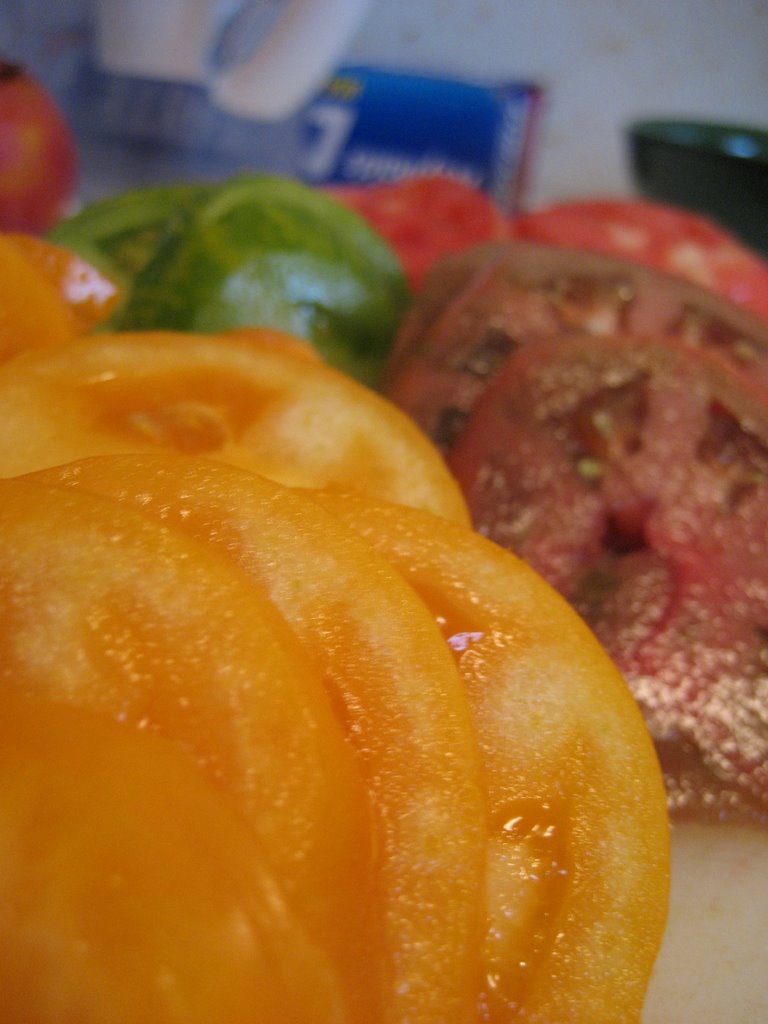
Jon and I, yet again, spent a Saturday morning braving the throngs of baby-strollers and nudgy couples laden with plastic bags at the local farmers market. We came home bearing piles of multi-colored heirloom tomatoes, herbs, peppers, berries and plums.

Unpacking our vibrant bounty, Jon examined a handful of fresh green arugula.

“This smells amazing,” he said.

“Give it to me,” I commanded, feeling scentishly bold.

I stuck my head in the green plastic bag and inhaled deeply. Light, peppery wafts registered in my nose. A cool nuttiness. I came up for air, beaming – every new scent brings back waves of sensory images, memories I didn’t even know I had. Jon, on the other hand, was more amused by the sight of my head in a bag, hence the picture.

While planning the party, I played around with different thematic ideas—my favorite being only to serve food-things that I can smell perfectly (a menu of chocolate and wine could not be all bad, if not exactly nutritionally sound) though the thought of decorating the apartment with large plastic-formed noses also appealed. In the end, however, we decided simply to begin with a small dinner gathering, with a great many more friends coming later for a less culinary-oriented party. I didn’t want to revel in what was—I just wanted to have a good time, a simple excuse for friends to come together.

And so in preparation, Jon and I spent the afternoon cooking. Throughout, I’ll admit, there were moments when surges of anxiety came rising from the back of my throat–anxiety that continued to baffle me with its sudden onset. It was still three days before the actual anniversary date. But, in retrospect, I think that imagining myself in the week before the accident was even more difficult than imagining what came next. A year and a few weeks ago I was in Italy with my family—hiking through the gold afternoon light of a Tuscan vineyard, tasting the abundance of blackberries growing on the side of the dirt roads, inhaling the sweet fields of wild lavender, looking forward to my impending travels in France and start date at the Culinary Institute of America. Knowing the shock of what was to come is what really grated against my mind, created bulbous waves of nausea as I stood in my apartment with Jon.


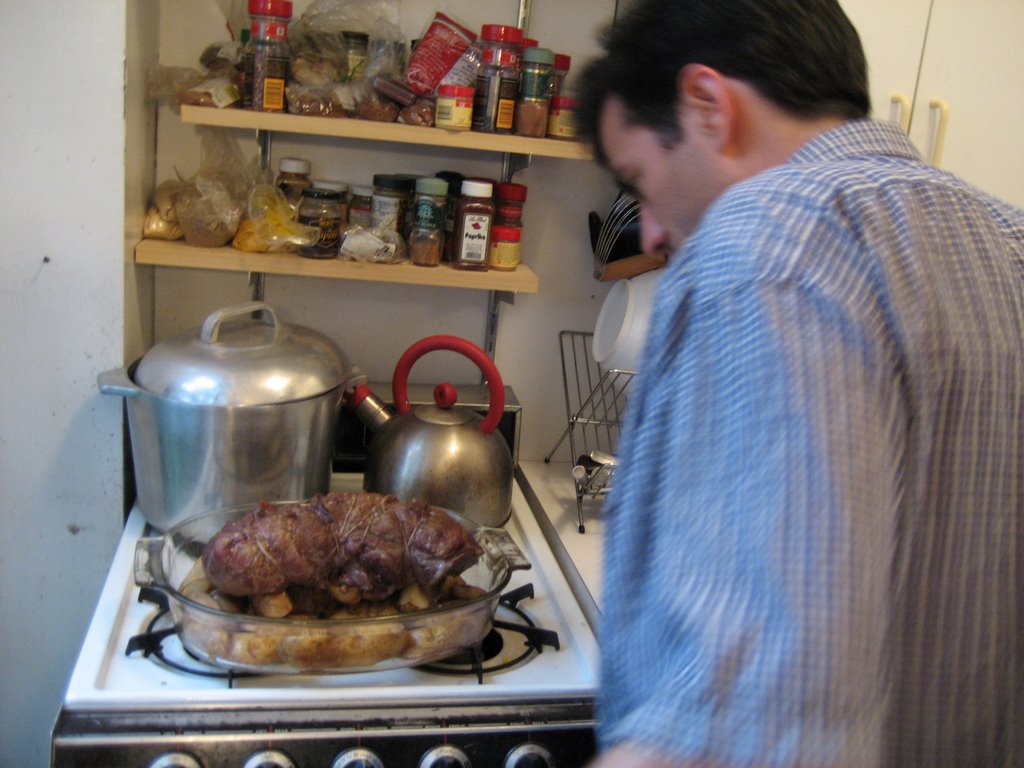
Cooking always helps me to relax, though. It has always been a way to ground myself. And Jon and I certainly can cook. We threw ourselves into the kitchen and created quite a feast: a puff pastry tart constructed with the pile of heirlooms, bright summer quinoa salad, tender lamb roasted on a bed of new potatoes and served with tarragon mustard, a rustic almond-plum buckle.


As we cooked, the scent of rosemary hovered about my head--fresh sprigs were lodged in the lamb as it roasted, perfuming the kitchen. Memory so intrinsically bound in scent, it brought me immediately back to a moment last November. I had been chopping the herb at my mother’s kitchen counter, balancing on my one good leg while my braced left knee dangled useless to the side, when I was suddenly, delightfully assaulted by its rich smell. It was the first scent to come back in full force after I lost that olfactory ability in the accident. And it was the first moment since that day in August that I thought, perhaps, I would be ok. Rosemary smells hopeful to me now.

The afternoon of cooking (pervasive anxiety attacks aside) was indeed a hopeful experience. More and more I find that each time I enter into the kitchen, something has changed.
As I chopped the garlic cloves and sprigs of cilantro for the quinoa salad, their smell burst into my brain in overwhelming waves. The newest of my regained scents, they still surprise me. It takes a while for my olfactory neurons and brain to register and recognize something new. If the source of smell is not right there in front of me I will stand still, breathing deeply and trying to put unattainable words to scent for a long time. The basic smell-related information hovers at the tip of my tongue. I often need someone to define for me what my olfactory neurons have forgotten. The garlic and cilantro on the cutting board beckoned with their familiar, close-to-forgotten smells; I’m happy that they still exist.

And as the heirloom tomato tart and, later, the almond-plum buckle baked in the oven the kitchen was filled with a nutty sweet warmth. Through this experience I have learned of the scent of temperature. Different than a physical measurement or sensation, there is something intrinsically olfactory about it. Try smelling a pot of boiling water; there is something there beyond the heat. It is a soothing, delicate washed perfume.


***


In the end it was a fun evening. There was eating, drinking, friends—an excellent way to celebrate the strange and dramatic turns that I have had this year.

At one point in the night I stood quietly in the sprawling crowd on my roof, and, for just a moment, watched the dappled Manhattan skyline in the distance. I felt calm and relaxed, for the first time all day. Anniversaries can be rough, as this city is clearly coming to terms with itself. I am just happy that I could make something fun come out of an experience that was not.

“If someone had told me last summer where I would be right now,” I thought, looking out at the city, “I don’t think I would have believed them.” It’s been an odd year.


Heirloom Tomato Tart with Capers and Caramelized Onions
adapted from Suzanne Goin's Sunday Suppers at Lucques

3 T extra-virgin olive oil
6 cups thinly sliced onions (1.5 pounds)
1 T thyme leaves
1 T butter (unsalted)
1 sheet frozen all-butter puff pastry, thawed
1 egg yolk
3 medium heirloom tomatoes, mixed colors
2 tsp capers
1/4 c Nicoise olives, pitted, sliced

Heat a large saute pan, add olive oild and then the onions, 2 teaspoons of thyme, 1 teaspoon salt and some pepper.

Cook for about 10 minutes, stirring often.

Turn down the heat to medium, add the butter, and cook for another 15 minutes, continually stirring, until the onions are caramelized and a deep golden brown. Let cool.

Preheat oven to 400F.

Put the defrosted puff pastry on a sheet of parchment paper on a baking pan. Score an 1/8 inch thick border around the sides with a knife. Whisk together the egg yolk with a teaspoon of water and then brush the mixture along the border. Spread the onions within.

Core the tomatoes and slice into 1/4 inch rounds. Place them on top of the onions spread evenly. Season with 1/4 tsp salt and some pepper.

Arrange the capers and olives on top, sprinkle with the remaining thyme.

Bake 10 minutes. Turn the pan around in the oven and bake for another 10-12 minutes, until the crust is a deep golden brown. Serves 8 as a first course.

Saturday, August 19, 2006

The Spotted Pig: Infinitely Better than Bad Art

On Wednesday night a work colleague and I stood in the wide expanse of a Chelsea warehouse turned art gallery. There were women dressed in bright, ruffled cocktail dresses and spindly stilettos, men in pressed suit jacket and ties. Shiny, perfectly tussled hair was ubiquitous. Small plastic cups were clutched in hand—sparkling roses and scotch on the rocks. There was an open bar; the line resembled a veritable mosh-pit of thirsty art supporters. The sun was setting and through the large windows we could see fading pink and purple cloud-streaks stretch out over the west river.

It was a charity art event; we were drawn to attend because of its swanky location, the press pass that granted us free entryway and, of course, its overarching good cause. The open bar and promise of food didn’t hurt, either. Once inside, however, it was pretty obvious that we didn’t fit in. We had walked over after work and were wearing jeans and bedraggled button down shirts, carrying bags of books and papers and not entirely sure what we were entering into.

The paintings on the walls were bright swaths of oil and acrylic and looked as if they were painted by an uninspired three-year-old. A chair-deemed-art was perched on a small stand near the window—clear plastic wrapped into an oblong shape and secured with small wire stands, an open hole at the bottom where, I can only imagine, you were supposed to uncomfortably seat yourself. The installation of small plaster donut-esque circles that hung on the wall was… mystifying at best. A beat-poet-turned-rapper was intonating harsh, vulgar lyrics into a microphone while no one listened. There were photographers and a cameraman there to capture the beautiful and the big names; we didn’t recognize anyone.

We positioned ourselves in a comfortable corner and were entertained watching the people and odd happenings around us. Our talk on the artwork nearby increased in decibel and crudeness with each glass of free wine. We were hungry, but the only way to partake in the hors d'oeuvres (because of the large, ravenous crowd) was to stand right next to the kitchen exit-way and practically pounce on the waitresses as they emerged with their loaded food trays. It became clear that this was not the place to stay for two starving, non-fancy people.

We looked at each other, eyebrows raised.

“How about The Spotted Pig?” he asked.

The words were like music to my ears.

“Absolutely perfect,” I said, beaming.

I have wanted to go to The Spotted Pig for a long time now. It is an old style gastro-pub in the West Village, owned by Ken Friedman and April Bloomfield and constructed with considerable help by Mario Batali. April Bloomfield, an English chef, has reinterpreted common bar food and brought it to an exciting, gourmet level. The restaurant/bar is always crowded—with celebrities and commoners alike—and promises some on the most illustrious people watching (Mario Batali himself, it is rumored, spends many a night drinking within its cozy walls til the early morning hours) and great late night food in New York. We immediately hopped in a cab and found ourselves at the door to the restaurant.

It was packed – crowded chatter and warmly lit interior – the hostess told us, “one hour, which is pretty good for us, for a table.” We climbed the stairs and plunked ourselves down at the second floor bar. Soon we had a menu, glasses of rioja, and decided to order an appetizer or two while we waited. I had not previously known that this colleague of mine, generally bogged down in editing a few offices away from my own, was a foodie. An excellent discovery, made even better when we found our taste in ordering to be the same.

“Devils on horseback? What do you think those are?” I asked.

“Um, I don’t have any idea. But it sounds exciting. Let’s order it.”

“Definitely. How about speck … have you ever had that?”

“No I haven’t…”

“Good, let’s get that too.” Unfortunately those hungry New Yorkers (with their penchant for the cured Italian meat made from hog’s legs) had cleaned the kitchen out of speck. We replaced it with an order of chicken liver toast—one of my favorite foods, so resplendent in my memory of when I lived in Italy.

Devils on Horseback ended up being sticky, juicy bites of bacon wrapped prunes, skewered on toothpicks and sweet with a spicy kick to its ending note. They disappeared quickly. The chicken liver toasts were rich and delicious, thick with olive oil and with a crunch of the thin bread. I fully admit that the bit of wine I had consumed and the hunger in the face of an 11pm dinner time may have influenced my taste buds – but that chicken liver toast was probably the best thing I have ever eaten.

We were soon led to a little table in the back corner nook of the restaurant. Deciding to split a few things we were soon face to face with a plate of pork tonnata with arugula—thin, pale pork slices that looked, in the dim light, almost like pasta—and a radish, parmesan and arugula salad. The bite of the radish alongside the salt of the cheese, tang of the lettuce and sweet note of the dressing were a great combination. The pork’s texture unnerved me a bit, so thin and yet so meaty—but the tuna-caper sauce was smooth provided a good foil to my initial unease.

At this point we could no longer deny that we were full. When our third dish arrived – the infamous Spotted Pig Burger (chargrilled with Roquefort cheese and shoestring fries) – we each had one bite before we had to call it a night. It would have been a travesty, that uneaten glory of red meat in front of us, if the thought of tomorrow’s office-bound lunch was not made infinitely better with such potential leftovers.

We stumbled out onto the street around 1 – a good six hours after our evening began – and walked a few blocks towards the subway in the suddenly cool New York evening air. Repressing the fact that we would both actually have to get up and go to work in the morning, I was happy and quite full.

Thursday’s work day, with a slight headache and general sleepy haze, was a little bit tough to get through. But the half burgers, taken simultaneously out at those two desks in our busy office, provided that necessary oomph of energy to get through the day.

Monday, August 14, 2006

On Returning to The Restaurant, One Year Later

“What does it smell like?” I asked my mom. We were sitting in her car, windows open, parked in a tiny lot in Cambridge, Massachusetts. Just coming off the recent heat wave, the breeze hitting the back of my neck was warm but not clammy, the sunlight tinted with that bronzed edge of a summer evening.

“It smells…good,” she said, inhaling deeply, “like… cooking.”

I peered out of the car window and looked at the a familiar red sign, next to a large brick building, a doorway and small set of stairs. The name of The Restaurant, emblazoned on the sign in white letters, was bigger than I remembered. We had a 7:30 reservation to eat dinner and I was not yet ready to open the car door. It had been a year since I was last in that parking lot, and it felt like a lifetime.

An older couple walked by on their way to the entrance—the woman in yellow and clutching a brown handbag, the man with white hair and stooped shoulders. He held the door open for her and she smiled before they disappeared together inside.

“Lets wait; just a minute,” I said. I was having a hard time getting the last words of The Chef out of my mind, thrown at me bitterly when I quit my job as a dishwasher and prep chef there at that restaurant last summer – You are an utter disappointment. I suddenly did not feel ready to face him again.

My mom and I sat silently in the car for another moment. Excitement, hope, exhaustion, dread—they were all rolled into a fuzzy lump somewhere in the back of my throat. Strong feelings for a simple dinner out, I know. But they were fitting—and familiar. It was the same thing I felt every night last year when I arrived to dishwash. They again bubbled to the surface of my consciousness in the parking lot. The only difference (besides the fact that my pants were not stained with beet juice or duck fat and my hair, perhaps, did not so closely resemble a bird’s nest) was that I could not smell the cooking which I remember permeating the air for blocks outside the restaurant. There was a monotone, olfactory nothingness where wafts of simmering veal stock and roasting chickens had previously inhabited my nose. Those smells, however, were so interlaced with the memory of that space and those feelings that sitting there in the car I could almost smell them again—the scent was on the tip of my tongue.

My heart was beating rapidly when I walked into the small, cozy dining room of The Restaurant. It was bustling with people. The waiters and waitresses were in jeans and white aprons, carrying bottles of wine, steaming plates. A light chatter of diners punctuated the soft jazz music; the walls and tables were warm in red and brown.

I smiled at the hostess, “Molly Birnbaum, reservation for two,” I said.

We were brought to a table deep within the dining room, my mom and I both in clicking heels and rustling summer skirts. It felt odd to be sitting there amid crisp linen and flickering candles, wearing make-up and jangling earrings—in my working past I had never spent more than five minutes in the dining room at one time. It was my first visit to The Restaurant since I left last year and the first formal dining experience ever. Looking around I was happy to see that I didn’t recognize anyone. I didn’t want to give the long, exhausting explanation of why I was no longer in the professional culinary world. I just wanted to eat. And drink. And toast to the fact that the one year anniversary of my accident is swiftly approaching and I am alive and well.

I soon saw a familiar face, however. A curly-haired waiter with whom I used to chat about books (in twenty second intervals, mainly about the most recent Harry Potter, while he was slicing lemons in the back hallway and I sped past lugging stacks of dirty dishes) came to our table bearing a pitcher of water. He did a double-take, glancing away and then back towards me again, not sure if he recognized me without those said stacks of dirty dishes. Without rivers of sweat running down my forehead I look different, perhaps.

“You’re Molly!” he exclaimed. I smiled, suddenly happy that my evening would not be completely anonymous. “I thought that was you!”

After a hearty greeting and rambling explanation of anosmia and why I am living in New York City and not at culinary school, he said, “I’ll tell The Chef that you’re here. He’ll want to know…” And he scooted off to attend to the rest of the busy dining room.

“You’re afraid of seeing The Chef, aren’t you Molly,” my mom said after the waiter left our table. “I can see that look of mild panic in your eyes.”

I nodded. Sighed. The whole evening made me nervous; the rest of my life felt very far away from dishwasher-Molly. “Hopefully he will just pay no mind to what the waiter tells him. He was so angry with me when I left—I highly doubt he cares that I am here. He still thinks that I’m at culinary school, still disappointed that I didn’t want to work my way up the line of his kitchen.”

My nagging apprehension disappeared, however, with the arrival of a bottle of wine. While perusing the menu, my mom’s eyes had immediately landed on a bottle of Sancerre; she had just read an article on the French wine made from Sauvignon Blanc grapes in the Loire Valley and really wanted to try it. A bit more expensive than we had intended, but, as she said with a playful grin, “we are here to celebrate an anniversary… and nothing says ‘I survived being hit by a car’ like great wine.” It was a crisp, white 2002 Sancerre "Jadis" Henri Bourgeois and after the first sip (ripe with tropical citrus, mint, a mineral breath) my mom’s wide smile and little wiggle-dance of happiness in her seat banished all of my worries.

When I worked at The Restaurant food was, obviously, the most important thing on everyone’s minds. It was a passionate culinary environment. There were certainly moments when I forgot about the food– moments involving maggots, black-outs, temper tantrums and surprising friends. Despite the general culinary intensity, though, I never once ate the food like it was intended to be served. I ate a lot, of course – a lot of wonderful, inspiring things. But never sitting at a table and never plated with the aesthetic precision that The Chef cared so much about. So when my first dish arrived that night in the dining room—a ragout of local forest mushrooms, snails, slow cooked fresh farm egg, garden herb puree and lavender blossoms—I had to spend a moment taking it in with my eyes. The bright yellow of the egg yolk balanced carefully on the muted brown mushrooms was complimented by the trickle of frothy, vibrant green puree. The delicate lavender was a soft purple punctuation to the pillow of egg white. It tasted like a rich, comfortable ramble through the woods.

On the shallow white bowl that contained my main dish there was a vivid stripe of orangey-red, skillfully curled from the center to rim – a sideline to the ricotta gnocchi and fresh garden vegetable glacee. It was a nectarine saffron emulsion and the color leaped into my eye-sockets, begging to be put to my lips, dancing with the bright colors of the vegetables alongside. I spent hours in the kitchen last year watching The Chef as he bent carefully over the row of white plates, holding a metal saucepan in one hand and long spoon in the other, and with expert, precise movements made swaths of colorful sauce marks under the dishes he was constructing. I always loved the way he moved – a large man making small movements in liquid flavor – the effect of the plate was heightened knowing the dance of orchestration behind it. Beautiful. The soft pounce of gnocchi was a texturally perfect foil to the vegetable crunch.

My mom’s creamy yellow potage of sweet corn was topped with crispy fried clams and kept the wine-inspired smile afloat on her face; it was continued by a rich olive oil and chorizo-broth poached sea bass.

For dessert we had an Ocumare chocolate brownie (gooey and rich, a subtle bitterness in the dark Venezuelan chocolate offset the sweetness) topped with homemade peanut butter ice cream (the whir of the oft-used ice cream maker in The Restaurant’s back kitchen ran in the back of my memory as we ate). In addition, we had the sour milk panna cotta; a square of milky white pudding flecked with black vanilla bean side by side with a pile of fresh blackberries. One bite and my mind was flooded with sensory images – when there was panna cotta left over, late at night and beginning to de-form in the large plastic tubs where it was stored during service, The Chef handed it off to me and S., my fellow dishwasher. The two of us would stand at a makeshift counter in the back hallway, talking in my broken Spanish, manning serious spoons, and eating that cold tangy cream until I thought I would burst. Those were wonderful moments. It was odd to be sitting, speaking in English, and eating a normally sized portion of that familiar dish.

After drinking a bottle of wine together, my low-tolerance mom and I were lost in a world of giggles. We were surprised when our waitress came out to the table not with our check, but with two tiny silver spoons, which she placed carefully down next to our hands. She smiled knowingly, disappeared and then came back a moment later with two small white cups on a tray.

“A special something from The Chef… rhubarb hibiscus soup with yogurt sorbet.” The soup was cold and feathery pink, tart and simultaneously sweet. The small dollop of yogurt sorbet was milky white. Small surprise courses from the kitchen were what The Chef called “VIP treatment procedures.” I was flattered and happy to be the recipient.

Later, my mom and I were taking bites of the buttery madeleine cookies that arrived with the check (how fitting, I know) when I looked up to see The Chef approaching our table. His hair, once long and dark and always kept in a rough ponytail, was short and manicured. He wore a blue shirt with his name embroidered on the right pocket, a clean white apron. His mouth was in a hard line.

I stood and shook his hand. My smile was wide, overtaking my face; I was suddenly so happy to see him, this man who taught me so much about food.

“The meal was wonderful,” I said, almost bashfully. “Thank you so much.”

“I’m glad you enjoyed it,” he said. A moment of silence. “So, what are you doing these days?” He looked at me pointedly and I was hit by a wave of embarrassment. I am not working my way up the culinary world, proving my pluck in the face of a good deal of physical opposition like I once was – instead I am sitting at a desk in midtown Manhattan, reading things. Under the glare of The Chef it seemed silly. But I explained, swiftly and in few words, about my accident… “only a few weeks after leaving the restaurant” and my loss of smell… “though it is slowly coming back”… my current quest to write in New York.

“Well,” he said slowly, shaking my hand again, “at least you still enjoy your food. Good luck to you, Molly.”

“Thanks.” I think I whispered.

Before we left I walked to the back hallway of the kitchen, out of view to those on the line, but still close enough to hear the clanging of pots and calling orders. S. was there, peeling garlic with his weathered hands, wearing a white shirt and jeans. I called out his name and his eyes lit up. He grasped my arm in greeting and we smiled at each other, perhaps a bit goofily. S. spoke about his life, always in Spanish, and I listened. This was always our relationship; I’m happy that I have somehow retained my ability to understand the language. When The Chef’s gruff voice called S. back into the kitchen we said goodbye. He gave me the number to his new phone.

My mom and I left The Restaurant and walked into a clear summer night. I had been afraid to go back and remind myself of what ‘was’. But on leaving I felt simply happy. Lucky. Full.


***


Tuesday morning of last week I ran hectically around my apartment looking for one of my black sandals. I couldn’t find it anywhere and I was going to be late for work. I jabbed a pair of big earrings into my ears as I searched my closet floor, not even sure what I was putting on. I tossed some books and papers into my bag, walking lopsidedly towards the kitchen while attempting to tie my hair back with my one free hand. I got down on my hands and knees, trying hard not to crush the smooth pleats of my linen dress and stuck my hand blindly under the futon. Just as my fingers grasped the heel of that lost shoe, my cell phone began to ring and I hopped up to answer.

“Hello? …Hello?” I said, hardly listening as I shoved my foot into the sandal and lunged towards the door to leave.

“Molly? Estas tu?” a low voice said, gravelly in phone-static. I immediately stopped moving, straining to hear. “Molly? Como estas?”

It was S. -- eight in the morning, just a few days after I returned from Boston. He called to tell me that he is happy that I am no longer washing dishes. He is happy that I found other work. Dishwashing is not for a “chica simpatica.” He had to repeat himself many times; my Spanish comprehension is better in person than on the phone. We talked as I walked slowly down the sunny sidewalk towards the subway, no longer caring that I was late for work. His voice was familiar and kind. Towards the end of our conversation he told me that the time I worked with him at The Restaurant was one of his happiest. When I was there I listened to him; we talked. He was happy. He wanted to wish me the best.

When I stepped onto the subway moments after hanging up the phone, my eyes stung. I felt lost in a throng of suits and heels, steamy breath and rustling papers. A baby was screaming and the woman standing next to me was immersed in her Blackberry. The world I inhabit these days is different; I could feel the tears begin to well over.
Sunday, July 30, 2006

farmer's markets, rooftop acrobatics and a tart

My roommate Jon and I are slowly recovering from this weekend's protracted culinary binge . We began Saturday morning, on a three-hour-long quest for groceries. We walked from our apartment, shiny with sweat after only a few steps in the sun, down to the farmer’s market in Grand Army Plaza—a vibrant weekend community of farmers, Brooklynites, red and yellow tomatoes, magenta beets, light fuzzed peaches and a phalanx of baby strollers. We spent a good deal of time poking around the piles of fat eggplants, mounds of green beans and stalks of scallions as we discussed cooking ideas and menu options. We loaded up bags with New Jersey tomatoes—their bulbous knobs ready to explode with summer-ripe red juice—a green pepper, thick-peeled red onions and cucumbers. The farmer manning the counter at this particular stand—lean and tan, white hair offsetting a youthful smile—threw in a free serrano pepper, grinning as we awkwardly hefted the eight pounds of tomatoes off his table. Soon we added bags of peaches, blueberries and plums, carrots and beans, fingerling potatoes, tiny tomatillos and a few loaves of fresh sourdough bread. When we finally left the market I felt as though I were carrying hundreds of pounds of produce, the bags literally hanging off of every balanceable body part. And when we arrived home, fingers permanently creased from the weight of grasping the heavy bags, we sat on the couch and stared at mounds of beets and broccoli, varying shades of carrots and onions, yellow plums, baskets of blueberries and sprigs of cilantro, slightly in awe of our lack of farmers market self control. Piled together and against the backdrop of our red brick (nonworking) fireplace, the vibrant colors and earthy vegetal shapes of our purchases were beautiful.

“If only we had some 17th-century Dutch artist living here,” Jon said, “Just imagine the still life paintings we would inspire.”

We were serenaded by Tom Wait’s familiar growl as we spent the afternoon blanching and peeling our bucket of tomatoes, chopping a few cucumbers, red onion and green pepper. Together with a hefty dose of garlic, olive oil, cilantro, white wine, lime juice and that (free) serrano pepper, I used the immersion blender in the largest soup pot we own to turn that tumult of vegetables into a smooth soup. Salt, pepper, and later garnished with avocado, onion and cilantro—it was an easy, cooling gazpacho with just a touch of crunch and spice. Friends slowly streamed in at the latter end of our prep work, sipping wine and experiencing the wonders of goat gouda and roasted tomatillos on bread.

Three fans collectively aimed into our kitchen made the summer heat somewhat bearable while we roasted our bi-colored carrots (yellow and orange), later tossed with the light crisp of chopped scallion. Steamed green beans, coated with a sweet balsamic vinaigrette, were cooked way ahead of time to be served cold with a pair of metal tongs. Jon had been inspired by a pilgrimage to a local Middle Easter grocery store to marinate our filets of blue fish with tangy green olives, preserved lemons, cumin, coriander and olive oil. Roasted, the soft fish was infused with deep flavor.

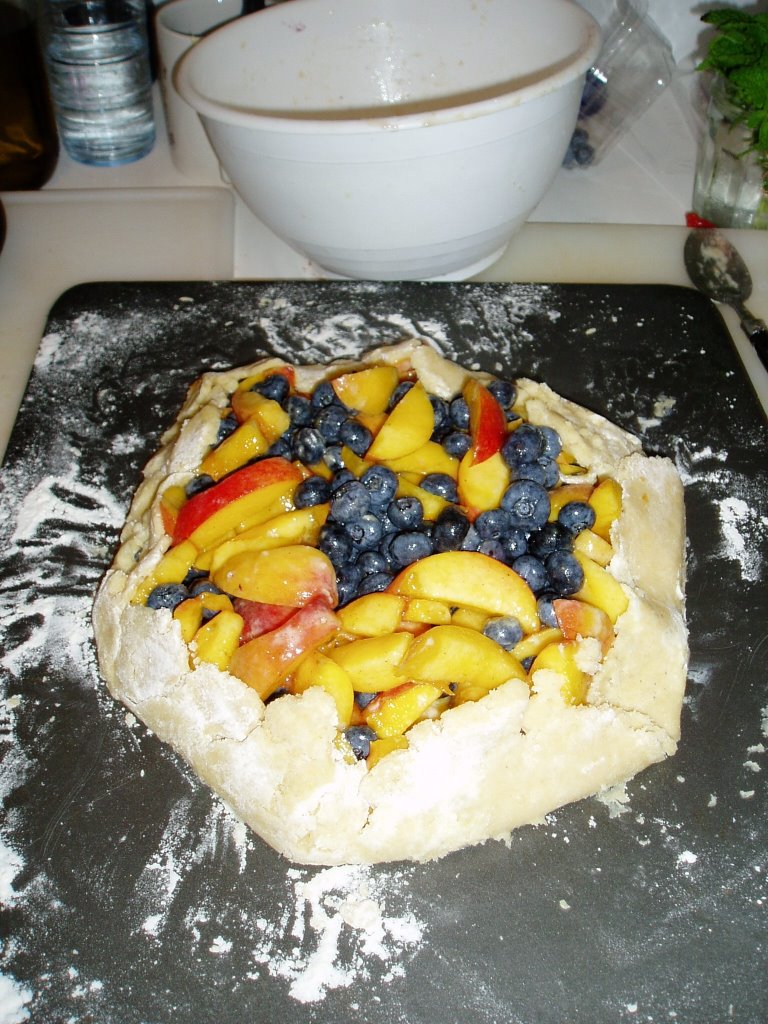
Last week, when Jon and I decided to throw this dinner party, I unearthed my ice cream maker from the back corner of my closet, somewhere behind the pasta roller and yogurt machine, under a pile of sweaters, sadly unused throughout this sweaty summer. And Saturday morning I went straight to work, heating cream, milk, vanilla and a bit of sugar in a heavy saucepan to a quiet simmer. In another bowl I whisked ten egg yolks—I love the slick feeling of the whites sliding through my fingers as I separate the yolks in the palm of my hand—with more sugar, until frothy and pale. After tempering the yolks with a bit of the hot cream mixture, I put it all together on the stove, stirring constantly as the custard thickened. Later that evening, the sound of the ice cream maker’s mechanical churn melded with the soft tunes of Leonard Cohen. The finished ice cream was a thick and off-white, smooth and rich, cold and creamy. It went perfectly with my peach-blueberry freeform galette (an old, favorite recipe which I’ve made and tweaked so many time I’m not even sure from where it began), the dough of which I rolled out with the help of an old wine bottle. When I pulled the tart out of the oven, fruit bubbling its thick syrup amid a deep brown crust, it smelled sweet and warm, faintly of cinnamon.

In an amazing feat of acrobatics—inspired by an apartment so thick with heat you had to practically swim through the air and, perhaps, a glass of wine or two—we brought our feast up to the roof. We handed shopping bags of bowls and plates, forks and knives, one heaping dish at a time to waiting hands, a chain of hungry people balanced on the precarious ladder, hefting food and people in awkward lunges through the hatch-like rooftop opening. Once up there, though, we perched on a picnic blanket, plates resting on our laps, and the sound of laughter reverberated out over our quiet, humid neighborhood streets. A clear outline of the Manhattan skyline gleamed in the distance—its light a deceptively still backdrop to an active evening of cooking, eating and a general raucously delicious time.

Freeform Peach-Blueberry Galette

Dough:
1 ¼ c flour
¼ c yellow cornmeal
½ tsp salt
3 tbs sugar
10 tbs unsalted butter, chilled and sliced
4-5 tbs ice water
1 large egg yolk, whisked with a dollop of water.

Filling:
8 small peaches
One container of blueberries
3 tbs. sugar
1 tbs. flour
Pinch of cinnamon
1 tsp lemon zest

Mix the flour, cornmeal, salt, sugar and butter together—I use my fingers to work the butter in with all of the dry ingredients. And then add the water, one tablespoon at a time, until the dough comes together. Wrap in plastic wrap and chill for at least an hour.

For the filling, slice the peaches and mix with the blueberries, sugar, flour, cinnamon and lemon zest in a bowl.

Preheat the oven to 400. And when ready, roll out the dough into a large circle. Place it on a piece of wax paper, on a cookie sheet, and then put the filling in the middle of the dough-circle. Carefully fold the overhanging sides of dough up over the edges of the fruit. Lightly brush the visible dough with the egg yolk and water mixture and sprinkle a bit of additional sugar on top. Bake (making sure to place tin foil or another pan underneath to catch the liquid overflow) for 30 minutes, until golden brown and bubbling.

Monday, July 3, 2006

A Tribute To Gaudi

A warm breeze tousled my loosely knotted hair and grated against my legs as we walked down the cobble-stoned street. There was no one else outside and, for a generally bustling city, it was oddly quiet. Dark buildings rose up around us as we strolled away from the downtown. We wound up a steep avenue, underneath a long train of white bed sheets that hung off clotheslines, drying in the wind. There were three of us: Dave, Adam and me. We moved together, large backpacks slung over our shoulders—silent in a horizontal line. Our shadows blazed out behind us in the midday sun.

It was Christmas Day; Barcelona, Spain.

That morning in the hostel the three of us had exchanged holiday gifts while perched at a rough wooden picnic table in the lobby. Books and journals were passed around, wrapped haphazardly in recycled newspaper; I was fresh from my semester studying art in Florence and giggled as I gave Adam and Dave each a pair of boxer shorts with a select digital image of Michelangelo’s David imprinted on them. Adam had just finished his semester in Bologna, Italy – and Dave in Sweden. Before we returned to our home college in the States we wanted a bit more adventure. Spain, France, Germany… Barcelona was our first stop and we were shocked by its warmth and color, somehow expecting Christmas to come with cold gray.

We left the hostel that quiet holiday morning, still groggy from a late night filled with paella and a midnight Christmas mass, and walked a long and meandering path to Park Guell. The park sprawls out on top of a hill overlooking Barcelona and was one of the few things open that day. It was designed by Antoni Gaudi, a Catalan architect famous for his fantastical, color-strewn buildings. We sat on a terraced landing—one that was wrapped with an undulating line of benches, covered in vibrant mosaic. There was the light smell of smoke; it wafted towards me from the gray, wrinkled man smoking a cigarette nearby. Children were shrieking in pleasure as they chased pigeons, running around in nonsensical circles. The air was warm. I could see the peaks and whorls of the Sagrada Familia, a wildly designed cathedral by Gaudi towering over in the distance of Barcelona.

Looking around, I felt as though I had landed in another world. The colorful buildings in the park—complete with gyrating design and often pinnacled roofs—may have jumped straight from my imagination. The quiet, winding wilderness paths throughout the park were a displaced proof of reality. Suddenly—with the warmth of this strange Christmas day, sitting on an oddly winding bench in Spain—I felt overwhelmingly aware of the physical world around me. The sun had never hit each hair on my arm so carefully. A puff of smoke had never carried with is such layers of scent. The mosaic on the bench around me screamed in vivid blue, pink, yellow, white. The sound of Dave unzipping his backpack was momentarily set in bold typeface. I felt my heart vibrating in my chest.

I had a few moments like that—flashes of shocking focus—while I traveled around Europe. The bright light of fireworks under the Eiffel Tower on New Years in Paris—a whiff of strong lilac perfume while I stood in front of Picasso’s Guernica in Madrid—a sweet mouthful of tart tatin in a small Parisian bistro—shivering through a snowstorm somewhere near Berlin. But never as wholly as in Park Guell. The vibrant awareness of what was around me was as its most acute in Barcelona.

I like to think that it was inspired by the world we sat in that Christmas Day: Gaudi's.

And how fitting, then, that the inspiration for my most recent moment of vivid corporeal awareness can also be connected to the Spanish architect. It was two weeks ago; I was far away from Europe and the sight of any architectural innovation. I sat in a stiffly linened and leathered dining room, midtown Manhattan. Clinking glasses and muted laughter, dark suits and shiny hair surrounded Becca and I, snug at a corner table. It was a moment of beautiful excess in our epic week of eating; we were dressed to the nines and eating a four course lunch at Le Bernardin.

Things have settled down in my life recently (after moving to NYC, finding a job etc.). There is a newly reinstated sense of control. And with that, the other senses seem to be rapidly reasserting themselves as well—comfort, confidence, not to mention scent. With my best friend and fellow food aficionado, Becca, across the table from me I was, for the first time, able to leave my loss behind and focus fully on what taste I do have.

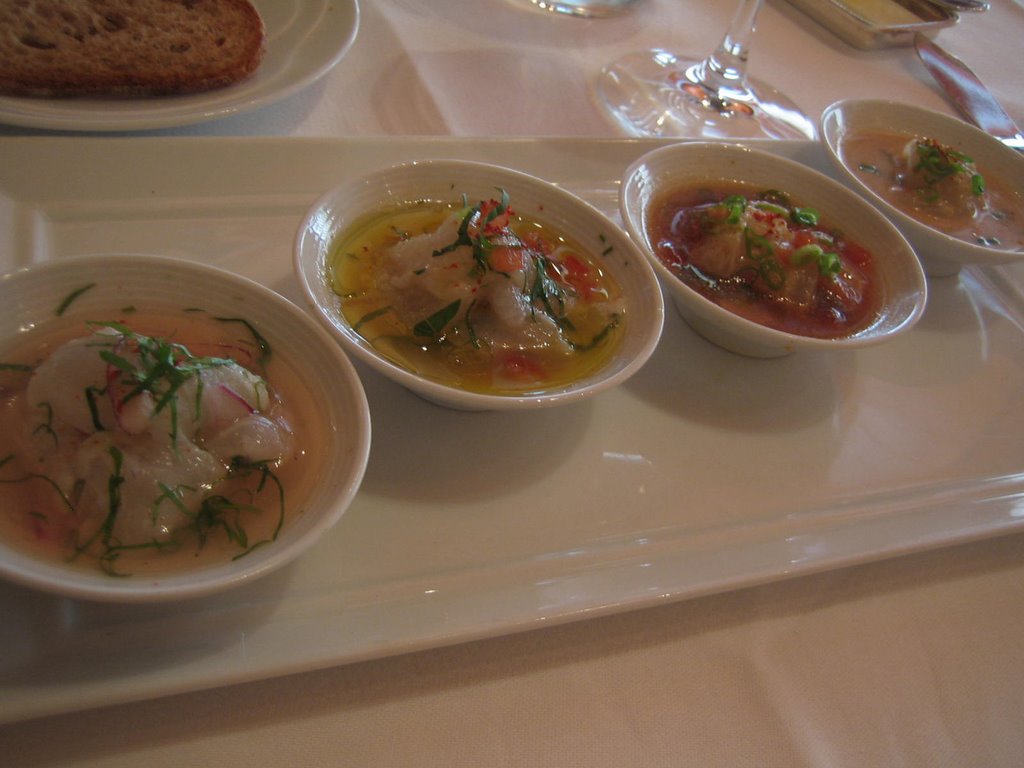
For my first course I had a “Progressive Tasting of Marinated Fluke: Four Different Ceviches; from Simple to Complex Combination.” The idea is to begin with the ceviche cup on the left (the simplest) and work your way to the right (the most complex). Each preparation had the same basic ingredients and as you moved along in complexity there were simply more flavors added. One at a time, I took a bite of each, slowly chewing, concentration on my limited scent and power of temperature and texture to find flavor. Becca followed suit. The fluke, a white flatfish, was cool and soft.

After the first: “Citrus, right? Salt and pepper?” I asked, wondering how much I could actually discern using texture, body and muted scent to taste. I could taste the tang and detect the fruity scent when I breathed out.

She nodded. “Yes, definitely. Lime, I think,” she said, “It’s light, though. Mainly I just taste the fluke.”

The Second: “Olive oil,” I said, a bit more definitive in my assertion. I could feel the silkiness of the oil coating the fish, soft in my mouth

“I agree—it’s thicker, more flavor in the olive oil that calms the citrus.”

The Third: “I can taste more salt—and a bit of a bite, which makes me think there is something vinegary… something Asian inspired…” I said.

“Soy sauce, I think,” Becca said, taking another mouthful, “or something similar.”

“And then there’s that crunch,” I said, “The green—scallions?”

“Jalapeno…” Which would make sense of the lingering spice in the back of my throat. “And shallots perhaps.”

The Fourth: “In this one I don’t even need to put a bite in my mouth to know the basic addition – the white milkiness is either cream or… coconut milk,” I contemplated.

“Tastes like coconut milk,” Becca said. “Curry too.”

“I can’t taste the curry, but the color gives that away to me.” The visual aesthetic of the food, I realize more and more, plays a huge roll in what my I can detect in taste. The orange-red on the plate gives direction to my olfactory neurons; it gives my brain a hint in discerning and making sense of weak scent. I took another bite. “I can, actually, taste a bit of curry flavor lurking around when I breathe out slowly. It’s weak, but vaguely sweet with a spicy bite.”

The texture of the coconut milk was strikingly similar to that of olive oil, the hint of thick viscosity. That feeling in the mouth, coupled with the light nutty flavors, implies inherant deliciousness. There is something undeniably palatable about the texture of a fat.

I tasted Becca’s first course, a Warm Sea Urchin Custard; Shiso Julienne, and was struck by its light milky texture. A smattering of foam on top was a salty foil to the rich cream. When I exhaled, slowly, I could taste the urchin; it was a briny sea-filled breath.

For the second course Becca had the “Skate-Pork” – a Surf and Turf of Crispy Pork Belly and Skate Wing, Gingered Squash Mousseline and Brown Butter Flavored Jus. I don’t remember my reaction to that dish as much because this was the point where Gaudi entered the equation and my taste buds were overwhelmed.

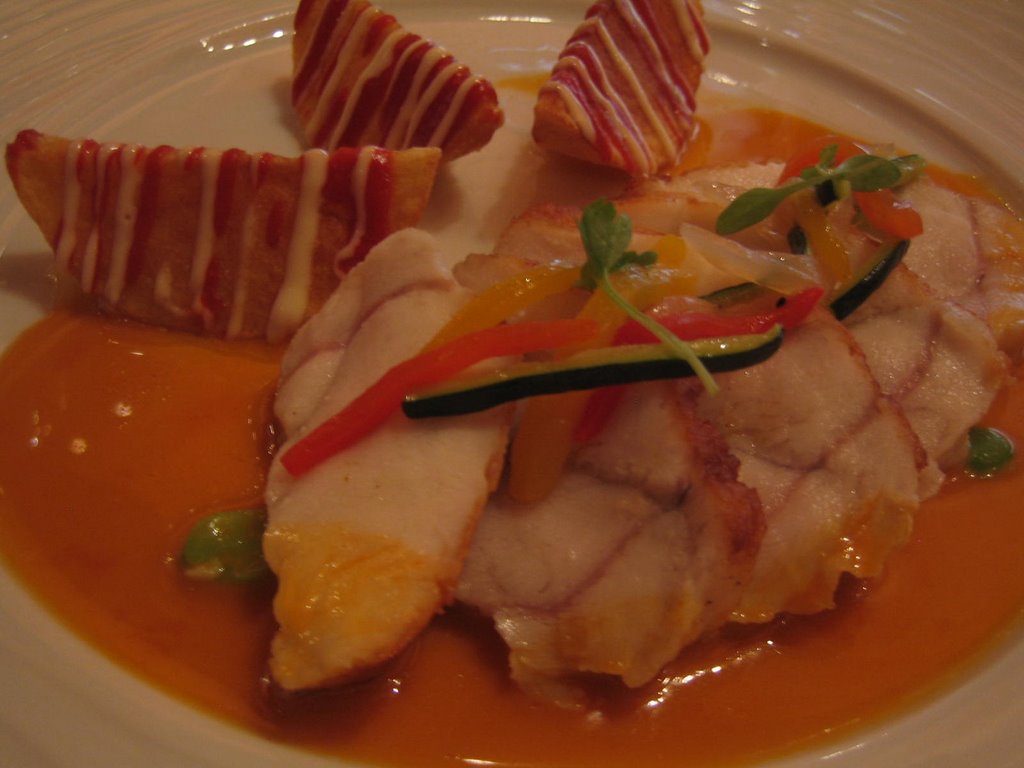
My own main course was the Monkfish, “A Tribute to Gaudi,” – Pan Roasted Monkfish; Confit Peppers and Fiery “Patatas Bravas,” Chorizo-Albarino Emulsion. It was a beautiful dish—carefully arranged with a few well placed barrages of color—slightly asymmetrical and just fantastical enough to implicate the Spanish architect in its conception. I took a moment to digest with my eyes, before attempting on my tongue.

What struck me the most in this dish was the texture of the monkfish—light and heavy simultaneously—smoothly flaking while dissolving softly in my mouth. The salt of the chorizo-albarino emulsion—a pale brown river running beneath the fish, complimented the sweet crunch of the pepper confit—a Gaudian swath of color pinnacled on the mountain of fish. The potatoes, three bronzed wedges angled on the side, were drizzled in white and red concentric lines of sauce—spicy and cool. It was a well balanced amalgamation of tastes, a flavor-tribute to Spain (I read somewhere that the Chef, Eric Ripert, spent part of his childhood in Barcelona). The nod to Gaudi in this dish would not have meant so much had I not already held a good deal of memory-infused value for his influence. And yet again while eating, I was acutely aware of all around me, all that went into me. I felt like I was tasting, both intuitively and intellectually, for the first time since the accident. Each taste was more vibrant and tangible than I had remembered possible. I think that had part to do with Becca’s comfortable presence and understanding, the high caliber and interest of the food itself, of course. But who knows, perhaps Gaudi’s presence infused within the meal gave me a subconscious but palpably heightened awareness of flavor.

For dessert I had the “Strawberry”: Strawberry, Mango, and Basil ‘Ice Cream Sandwich’ and Organic Strawberry Juice—sweet and cold between the fresh crunch of strawberry meringue. Becca’s “Chocolate-Cashew”: Dark Chocolate, Cashew and Caramel Tart, Red Wine Reduction, Banana, and Malted Rum Milk Chocolate Ice Cream was thick and understated in its sweetness. The only thing we did not like the entire afternoon was Becca’s ice cream; we aren’t malted rum sorts of people, really.

The waiter then brought us a white napkin filled with piping hot mini cookies; I could smell their sweetness. They tasted warm.

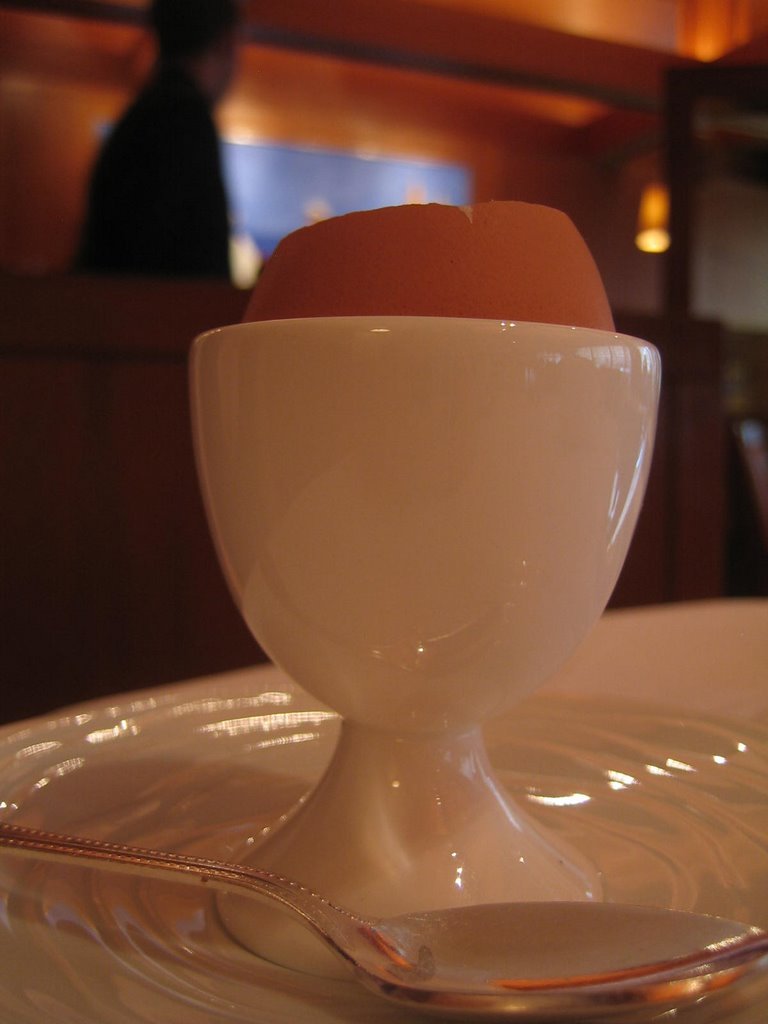
And then, surprised, small white vaulted cups were place before us. In each was an egg shell, open on top. “From the kitchen,” the waiter said with a smile. Inside the egg was a delicately balanced milk chocolate pot de crème, caramel foam, maple syrup with a smattering of Malden sea salt sprinkled on top.


“I saw Michael Laiskonis, the pastry chef here, on Iron Chef America,” Becca said excitedly. “For the coconut and chocolate battle he made this! Well, with coconut, but still, everyone loved it! Especially Jeffrey Steingarten, one of the judges that night. I remember so clearly, because he made me laugh when he said the only thing he would change about this dessert would be to put it in an ostrich rather than a chicken egg….”

It was a wonderful combination of salty and sweet (of which I am already an unabashed fan). I would certainly have eaten an ostrich egg full.

We left Le Bernardin a bit giddy from the rich food and unaccustomed glass of afternoon wine and went for a walk in the park. A warm breeze tousled my loose hair and I could (almost) smell the scent of summer hanging in the air.